

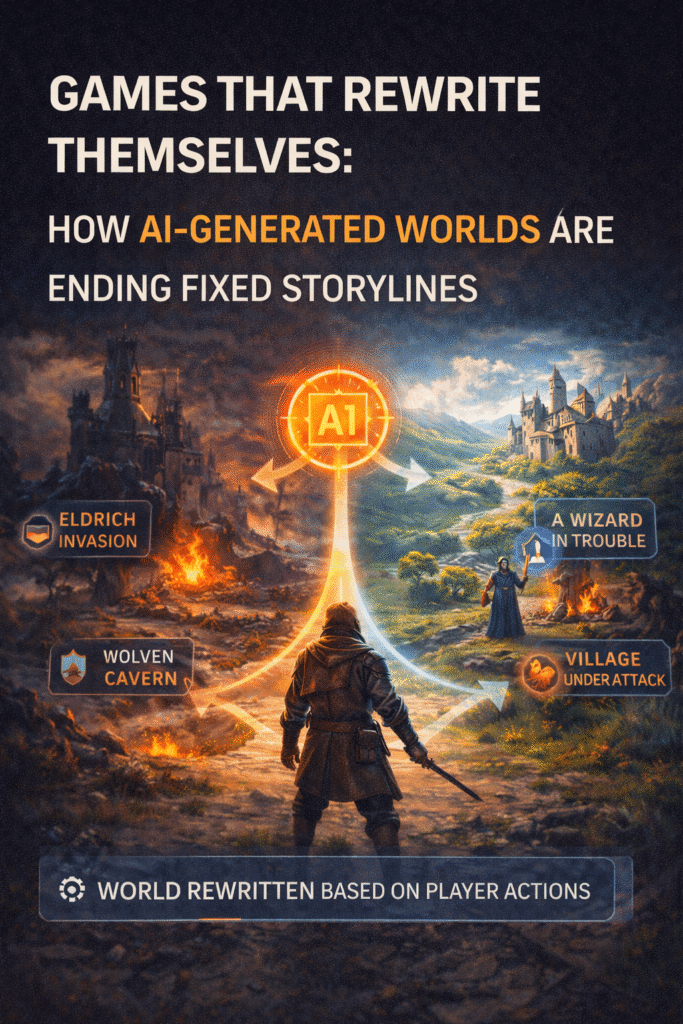
What if a game never played the same way twice?
Not because of random events —
but because the world itself is being generated, rewritten, and reshaped by artificial intelligence while you play.
In 2025, games are no longer static experiences.
They are becoming living systems that create content in real time.
And this shift is changing what “story” even means in gaming.
🧩 What Are AI-Generated Game Worlds?
AI-generated worlds use machine learning models to create:
landscapes
cities and buildings
quests and objectives
enemy behavior
dialogue and lore
Instead of designers hand-crafting every detail, AI builds the world dynamically based on how players interact with it.
The game doesn’t just respond —
it creates.
⚙️ Why This Became Possible Only Recently
For years, procedural generation existed — but it was shallow.
In 2025, three major breakthroughs changed everything:
AI can now understand narrative structure
Real-time generation works without loading screens
Player behavior can influence world logic
This allows AI to generate content that feels intentional, not random.
🗺️ Why No Two Players See the Same World
Your choices matter far beyond dialogue.
AI systems track:
how you explore
what you avoid
how aggressive or cautious you are
what kind of rewards you chase
If you prefer stealth, the world adapts with tighter spaces and hidden paths.
If you rush combat, the world grows harsher and more dangerous.
The environment evolves to match you.
📖 The Death of Fixed Storylines
Traditional games have beginnings, middles, and endings.
AI-driven games don’t.
Stories emerge from:
player decisions
unexpected failures
AI-created conflicts
world events that weren’t scripted
There is no “true ending.”
Only outcomes.
Players are no longer following a story —
they are creating one without realizing it.
🔥 Why This Trend Is Going Viral in 2025
Social media is filled with:
completely different endings
unique story arcs
emergent moments no developer planned
world events triggered by small decisions
Players aren’t sharing walkthroughs anymore.
They’re sharing experiences that can’t be copied.
That uniqueness drives virality.
🎮 Genres Being Transformed the Most
This technology is reshaping:
open-world RPGs
survival games
sandbox games
strategy simulations
roguelike hybrids
Games feel endless — not because they’re large,
but because they never stop evolving.
⚠️ The Hidden Challenges of AI Worlds
AI-generated worlds also raise concerns:
loss of author-driven storytelling
balancing difficulty dynamically
quality control at scale
ethical limits on AI decision-making
Some players love the chaos.
Others miss handcrafted perfection.
This debate is growing fast — and so is interest.
🔮 What the Future Holds
Soon, games may:
generate entire universes on demand
create lore as you explore
remember world history across saves
evolve civilizations over time
remove the concept of “completion”
Games won’t be finished.
They’ll be ongoing.
🏁 Final Thoughts
AI-generated worlds mark a turning point.
Games are no longer products you consume.
They are systems you inhabit.
When the world adapts to you —
every playthrough becomes personal,
every story becomes unique,
and every experience becomes impossible to replicate.
The future of gaming isn’t scripted.
It’s created — moment by moment — by you.


