

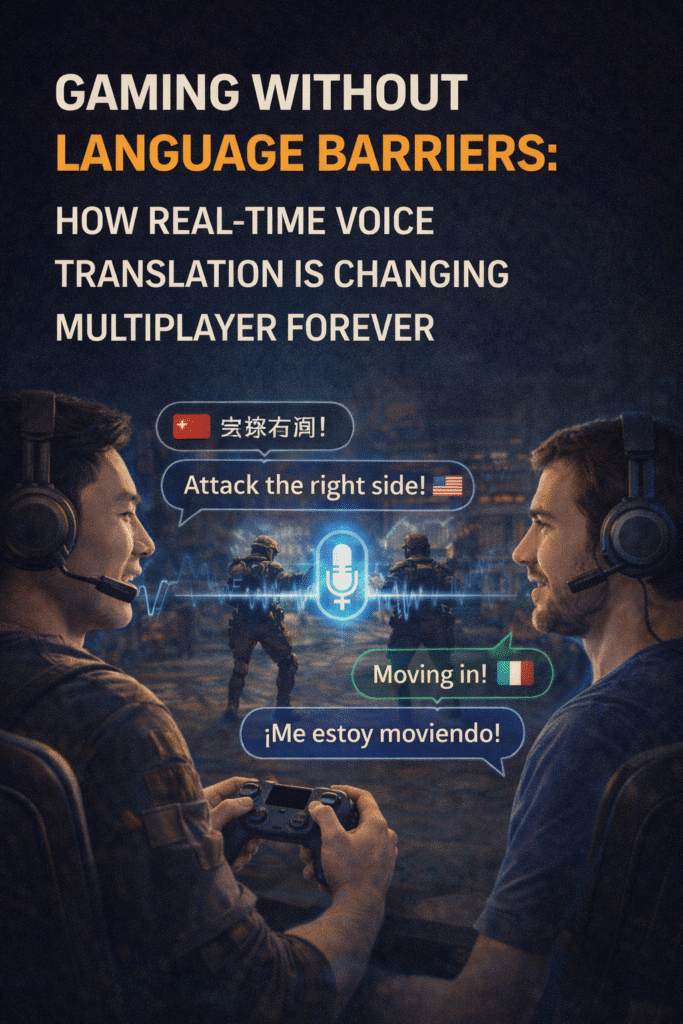
For years, multiplayer gaming had one invisible wall.
Language.
You could play with anyone in the world — but you couldn’t always communicate with them. In 2025, that barrier is finally breaking.
Real-time voice translation is quietly transforming online gaming, allowing players who speak different languages to talk, strategize, and compete as if they shared the same tongue.
This isn’t a future promise.
It’s already happening — and it’s going viral.
🌍 The Global Problem Multiplayer Always Had
Online gaming has always been global.
Servers connect players from:
Asia
Europe
North America
South America
But teamwork suffered because:
- voice chat was language-locked
- text chat slowed gameplay
- players avoided communication altogether
Competitive coordination was often limited by who spoke which language — not skill.
🧠 What Is Real-Time Voice Translation in Games?
Real-time voice translation uses AI to:
- listen to a player’s voice
- detect the spoken language
- translate it instantly
- replay it in another language
All of this happens in milliseconds — fast enough for live gameplay.
You speak normally.
Your teammate hears you in their own language.
No subtitles. No menus. No delays.
⚙️ Why This Technology Finally Works in 2025
Earlier attempts failed because translation was slow and inaccurate.
Three things changed.
First, AI speech recognition improved dramatically — even with accents, slang, and gaming terms.
Second, low-latency cloud processing allows translation to happen almost instantly.
Third, game engines now integrate voice AI directly instead of relying on external apps.
The result: translation fast enough for ranked matches.
🎮 How PC and Console Multiplayer Are Being Transformed
In team-based games, communication is everything.
Real-time translation allows:
- mixed-region squads
- global matchmaking without fear
- better coordination in ranked play
- new friendships across borders
Strategy games, shooters, and MOBAs benefit the most — where seconds and clarity matter.
Skill finally speaks louder than language.
📱 Mobile Gaming Makes Global Play Effortless
Mobile gaming is driving massive adoption.
Mobile players already rely heavily on voice chat due to:
- smaller screens
- fast sessions
- touch-based controls
Built-in translation makes global lobbies feel local — one reason mobile multiplayer continues to grow at record speed.
🏆 eSports and Competitive Play Get Truly International
In professional gaming, language barriers often forced teams to:
- share one common language
- use translators
- limit roster diversity
Real-time translation opens doors to:
- international team compositions
- broader talent scouting
- smoother global tournaments
Communication advantage is no longer limited by nationality.
🔥 Why This Topic Is Going Viral
Gamers are shocked by how natural it feels.
Online discussions are exploding around:
- finally understanding teammates
- less toxicity caused by miscommunication
- more inclusive matchmaking
- friendships forming across continents
Many players say it makes multiplayer gaming feel “new” again.
⚠️ The Challenges Ahead
This technology still raises concerns:
- voice data privacy
- AI moderation accuracy
- misuse or impersonation
- emotional tone translation
Developers must balance innovation with trust — or risk backlash.
🔮 What the Future of Voice AI in Games Looks Like
In the near future, we may see:
- emotion-aware translation
- voice-to-voice NPC interaction
- live commentary translation for streams
- AI teammates that talk naturally
- universal voice chat across platforms
Games won’t just connect players.
They’ll help them understand each other.
🏁 Final Thoughts
Gaming has always been global — but communication wasn’t.
Real-time voice translation changes that forever.
When players can speak freely, plan instantly, and connect naturally — regardless of language — online gaming becomes more human.
The next evolution of multiplayer isn’t better graphics or faster servers.
It’s understanding.
And that may be the most powerful upgrade gaming has ever received.


