

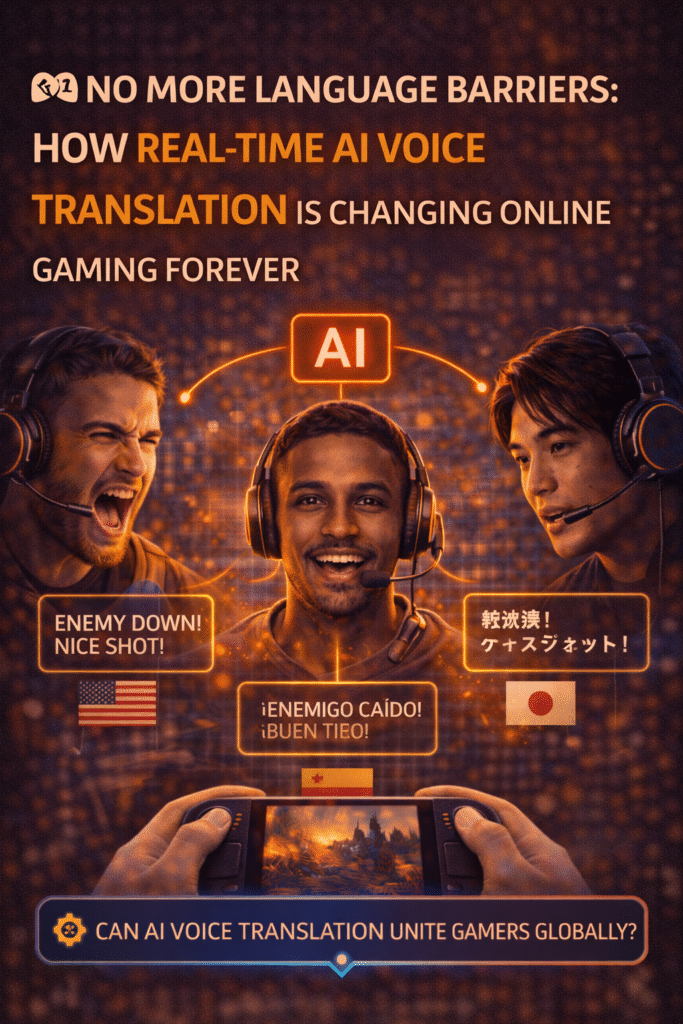
For years, multiplayer gaming had an invisible wall.
You could play with anyone around the world —
but you couldn’t always talk to them.
In 2025, that wall is finally breaking.
Real-time AI voice translation is entering online games, allowing players who speak different languages to communicate instantly — naturally — during live gameplay.
And this single technology could redefine global multiplayer gaming.
🌍 What Is Real-Time Voice Translation in Games?
Real-time voice translation uses AI to:
listen to spoken voice
translate it instantly
reproduce it in another language
preserve tone and emotion
All of this happens while the match is running — with almost no noticeable delay.
You speak in English.
Your teammate hears it in Spanish.
Another hears it in Japanese.
Everyone hears a natural voice — not robotic text-to-speech.
🚀 Why This Technology Is Exploding in 2025
This didn’t work well in the past.
Now it does — and here’s why.
🧠 AI Language Models Finally Understand Context
Earlier translators failed in gaming because:
slang confused them
callouts were misunderstood
fast speech caused errors
Modern AI understands:
gaming terminology
emotional tone
shouted commands
context-based phrases
“Enemy behind” no longer turns into nonsense.
⚡ Low Latency Makes It Playable
Thanks to:
edge computing
optimized audio models
dedicated voice pipelines
Translation now happens in milliseconds — fast enough for competitive play.
For the first time, language translation keeps up with reflexes.
🎯 How This Changes Multiplayer Gaming
This isn’t just a quality-of-life feature.
It fundamentally changes who you can play with.
🤝 Truly Global Teams
Ranked matches no longer need language-based matchmaking.
Players from different regions can:
coordinate strategies
share callouts
build chemistry
Your skill matters more than your location.
🔥 New Life for Competitive Games
Games that struggled in certain regions now benefit from:
larger player pools
faster matchmaking
more balanced teams
A dying server can become global again.
🎤 Voice Chat Without Toxicity Filters
Some systems also analyze voice tone.
AI can:
detect verbal abuse
soften aggressive speech
block insults without muting gameplay communication
This creates calmer, more playable voice chat environments.
📈 Why This Topic Is Going Viral
Because it solves a problem players accepted for years.
Gamers are sharing clips of:
perfectly translated clutch callouts
funny cross-language moments
unexpected friendships across regions
It feels futuristic — and personal.
⚠️ The Privacy Concerns Nobody Can Ignore
Of course, there’s a tradeoff.
Questions gamers are now asking:
Are voice recordings stored?
Is speech used to train AI?
Can voice data be analyzed beyond translation?
Voice is identity — and that makes this tech sensitive.
💰 How This Affects Streaming and Esports
For creators and tournaments, this is huge.
Streamers can:
reach international audiences live
interact with global chats
collaborate across languages
Esports events can:
merge regional leagues
reduce localization costs
reach wider audiences
Competition becomes truly worldwide.
🔮 What the Future Looks Like
In the next few years, we may see:
emotion-preserving voice translation
custom voice filters per player
language-free global lobbies
cross-region esports teams
AI voice assistants integrated into games
Language may stop being a barrier in gaming entirely.
🏁 Final Thoughts
Gaming has always been about connection.
Real-time AI voice translation doesn’t just improve communication —
it changes who you can connect with.
When language disappears, what’s left is pure gameplay, strategy, and teamwork.
The next generation of multiplayer games won’t ask:
“What language do you speak?”
They’ll ask:
“Can you play?”
And that could be one of the biggest shifts in gaming history.


