

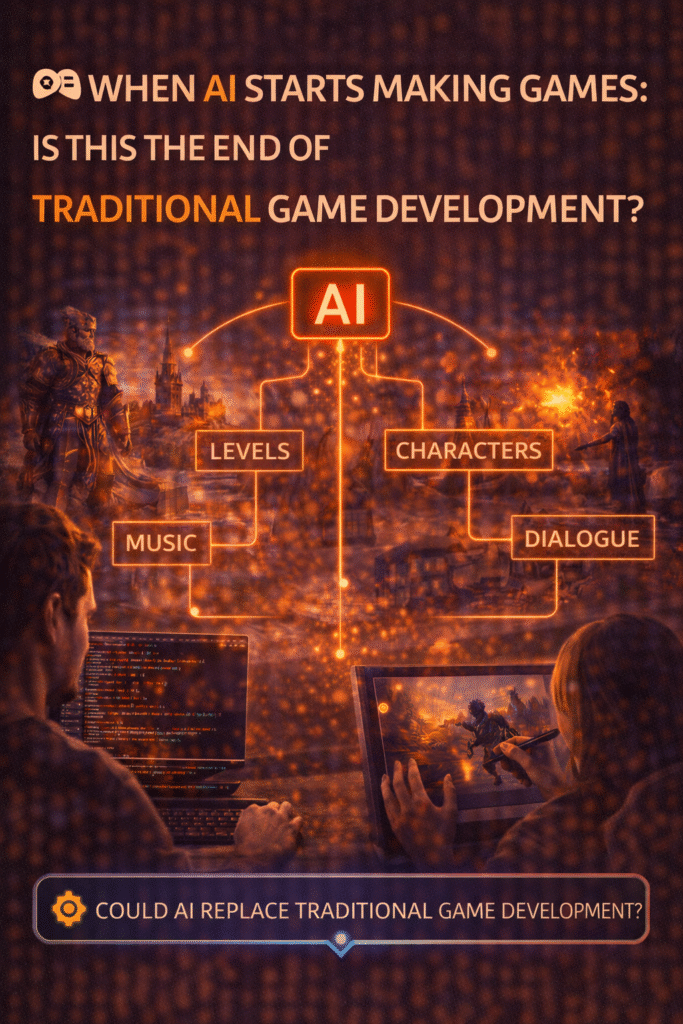
For decades, making a game required massive teams.
Programmers wrote code.
Artists built assets.
Designers crafted levels.
Writers scripted stories.
In 2025, something disruptive is happening.
Games are starting to build themselves.
AI tools are now capable of generating levels, characters, music, dialogue, animations, and even core mechanics — in minutes.
And that is shaking the gaming industry from the inside.
🤖 What Is AI-Generated Game Development?
AI-driven development uses machine learning models to:
- generate 3D assets
- create realistic animations
- design maps automatically
- write branching storylines
- balance weapons and mechanics
- compose background music
- test gameplay internally
Instead of building everything manually, developers guide AI systems that do the heavy lifting.
The result? Faster production. Lower costs. Bigger ideas.
🚀 Why This Is Trending in 2025
Three major breakthroughs pushed this into the spotlight.
1️⃣ Generative AI Became Production-Ready
Early AI tools were experimental.
Now, they can generate:
- playable level layouts
- high-quality textures
- natural character dialogue
- cinematic cutscenes
Indie developers can now compete with studios that once had 200+ employees.
2️⃣ AI Can Balance Games Automatically
Balancing weapons, skills, and progression used to take months.
AI now simulates thousands of matches instantly to detect:
- overpowered items
- unfair advantages
- difficulty spikes
Games launch more refined than ever before.
3️⃣ Player-Created Games Are Exploding
Some platforms now allow players to:
- describe a game idea in text
- instantly generate a playable prototype
- modify mechanics using prompts
This is turning gamers into developers overnight.
🎯 How This Changes the Industry
AI doesn’t just speed things up.
It changes who gets to create.
🎨 The Rise of Solo Game Creators
One person with AI tools can now build:
- full RPG worlds
- competitive multiplayer games
- story-driven experiences
The barrier to entry is collapsing.
🌍 Infinite Game Content
Procedural generation is evolving into something bigger.
Imagine:
- infinite quests generated on demand
- endless unique dungeons
- stories that adapt forever
- characters created dynamically
Games may never truly “end” again.
🔥 Why This Topic Is Going Viral
Because it creates tension.
Gamers and developers are debating:
Will AI replace artists?
Will creativity suffer?
Will games feel soulless?
Is this empowering or dangerous?
When technology threatens creative industries, it sparks strong reactions — and that drives attention.
⚠️ The Big Concerns
AI-driven game creation raises serious questions.
Who owns AI-generated assets?
Can AI copy existing art styles unfairly?
Will studios cut jobs?
Will originality decline if AI trains on past games?
The industry is excited — but cautious.
🧩 What Happens to Traditional Developers?
The role of a game developer is evolving.
Instead of building everything manually, developers may become:
- creative directors of AI systems
- prompt engineers
- experience designers
- AI supervisors
Human creativity won’t disappear —
but the workflow will transform.
🔮 What the Future Looks Like
In the next few years, we may see:
- AI-generated open worlds in real time
- personalized storylines per player
- auto-updating live games
- games that rebuild themselves based on trends
- players co-creating worlds with AI mid-game
The line between playing and developing may blur completely.
🏁 Final Thoughts
Gaming started with simple pixels and a few lines of code.
Now, we are entering an era where code can write code —
and games can help create themselves.
The real question isn’t:
“Can AI make games?”
It’s:
“How will human creativity evolve when it no longer has limits?”
And that might define the next generation of gaming.


