

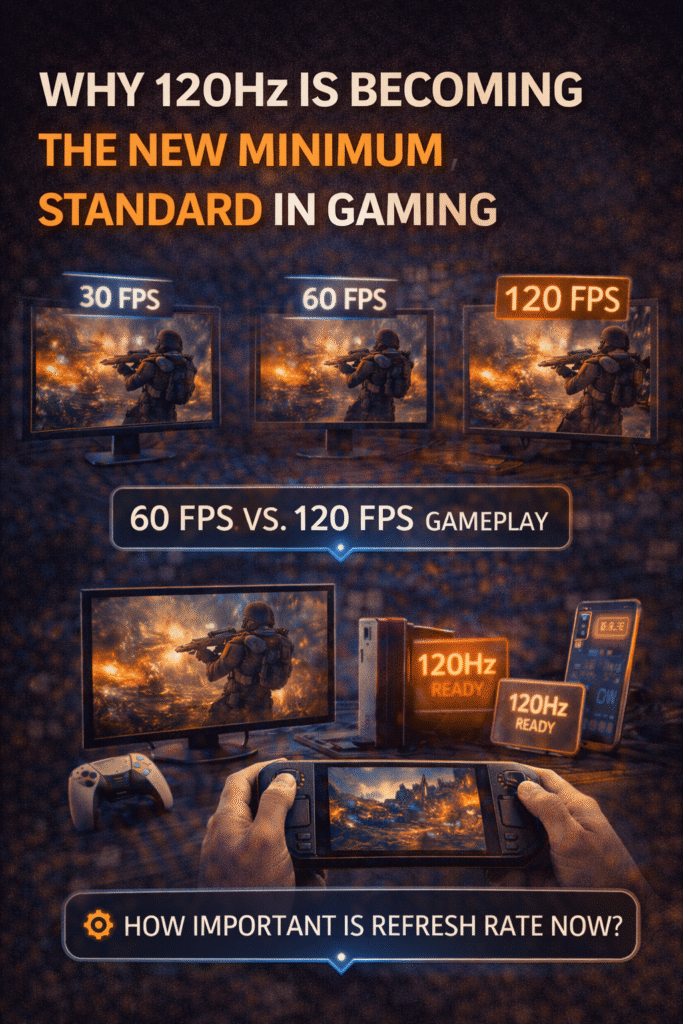
Once upon a time, 30 FPS felt smooth.
Then 60 FPS became the gold standard.
In 2025, that standard is quietly being replaced.
Gamers across PC, consoles, and even mobile are now asking:
Why does anything below 120Hz feel broken?
This isn’t hype — it’s a technological shift that’s changing how games are built, played, and reviewed.
🖥️ What 120Hz Actually Changes
120Hz doesn’t just make games “look smoother.”
It fundamentally changes how they feel.
Every second:
inputs register faster
camera movement becomes fluid
motion blur is reduced naturally
The difference isn’t subtle.
Once you experience 120Hz, going back feels uncomfortable.
🎯 Input Lag Is the Real Game-Changer
Higher refresh rates reduce the delay between:
your input
on-screen response
In competitive games, this means:
faster reaction times
more accurate aiming
better movement control
Skill expression improves — especially in shooters, racing games, and fast action titles.
🎮 Why Consoles Are Pushing 120Hz in 2025
Modern consoles now officially support:
120Hz modes
variable refresh rate (VRR)
low-latency pipelines
Developers are prioritizing:
performance modes over raw resolution
stable frame pacing
lower latency experiences
Players are choosing smoother gameplay over ultra-high visuals.
📱 Mobile Gaming Is Quietly Following
High-end smartphones now ship with:
120Hz and 144Hz displays
touch sampling rates above 300Hz
Mobile competitive games feel:
more responsive
less jittery
more precise
Mobile esports wouldn’t function at today’s level without high refresh screens.
🎥 Why Game Reviews Are Changing Their Criteria
Reviewers are no longer asking:
“Does it run at 60 FPS?”
They’re asking:
Is the 120Hz mode stable?
Does performance mode feel consistent?
Is VRR implemented properly?
Frame pacing and refresh stability are now review-critical metrics.
⚠️ The Downsides No One Likes to Mention
120Hz isn’t free.
Higher refresh rates demand:
more GPU power
better cooling
higher battery usage
On lower-end devices, developers must choose:
visual quality or smoothness
This tradeoff defines modern game design.
🔮 What the Future Looks Like
By the end of the decade:
60Hz may feel like 30Hz once did
120Hz will be the baseline
240Hz will define competitive play
adaptive refresh will be standard everywhere
Games will be built for responsiveness first — visuals second.
🏁 Final Thoughts
The 120Hz shift isn’t about specs.
It’s about how games feel.
Smoother motion.
Faster reactions.
Better control.
In 2025, smoothness is no longer a luxury.
It’s an expectation.
And once players feel the difference —
there’s no going back.


