

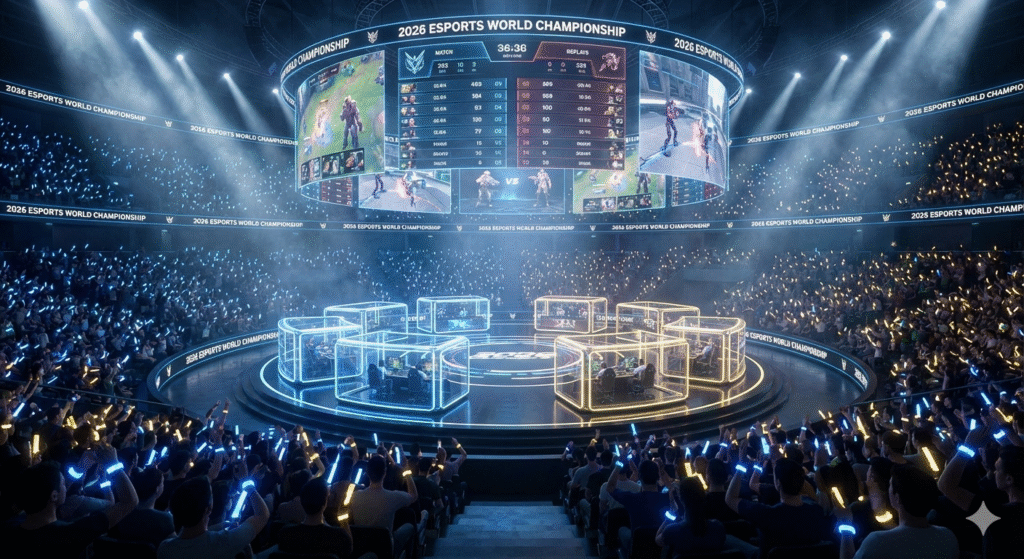
If the early 2020s were characterized by “explosive, unchecked growth,” 2026 is the year of The Great Stabilization. eSports has officially graduated from a digital subculture to a mature, high-stakes global entertainment pillar. With an audience projected to exceed 640 million this year, the focus has shifted from “getting people to watch” to “deepening the experience” through AI, mobile accessibility, and national pride.
Here is your field guide to the professional gaming circuit in 2026.
I. The Rise of the “Mega-Festival” Model
The era of isolated, single-game championships is being eclipsed by the Multi-Title Mega-Festival.
- The Riyadh Pillar: The Esports World Cup 2026 in Saudi Arabia has become the center of gravity for the industry. Spanning nearly two months, it hosts dozens of titles simultaneously, forcing organizations to build “super-rosters” that compete across multiple genres to win the overall Club Championship.
- National Identity: We are seeing a massive surge in nation-based competitions like the Esports Nations Cup. Much like the FIFA World Cup, these events allow fans to cheer for their country rather than just a private organization (like T1 or G2), bringing in a whole new demographic of “casual” viewers.
Olympic Update: While the Olympic Esports Games were originally slated for 2025, the IOC has moved to a “Road to 2027” strategy. This delay is actually a win for the industry, allowing for better alignment between game publishers and Olympic standards of fairness.
II. AI: The Invisible Coach and Cameraman
In 2026, AI is no longer a buzzword; it’s a prerequisite for winning.
- AI-Native Training: Professional teams now use tools like Itero and Mobalytics to simulate millions of match scenarios. These “Digital Twins” of opposing teams allow pros to practice against an AI that perfectly mimics their rival’s aggressive tendencies or warding patterns.
- The “Perfect” Broadcast: For viewers, AI now handles real-time “Highlight Generation.” If you join a stream 30 minutes late, an AI-generated summary instantly shows you the three most critical team fights you missed, tailored to your favorite players.
- Anti-Cheat 2.0: On-device AI NPUs (Neural Processing Units) now scan for hardware-level cheats and “pixel-bots” in real-time, restoring a level of competitive integrity that was under threat just two years ago.
III. The 2026 Global Power Rankings (Q1)
| Title | Current Meta Status | Major 2026 Event |
| League of Legends | The Structural King | LoL World Championship (Oct) |
| Counter-Strike 2 | Tactical Perfection | IEM Cologne Major (Aug) |
| Valorant | Character-Driven Dominance | VCT Champions 2026 |
| Mobile Legends: BB | Mobile Juggernaut | M7 World Championship |
| Dota 2 | The Strategic Masterclass | The International 2026 |
IV. Mobile-First: The New Frontier
While the “Cathedrals of Counter-Strike” in Europe remain iconic, the raw numbers have moved to Southeast Asia, India, and Brazil.
Mobile Legends: Bang Bang (MLBB) and PUBG Mobile are regularly out-drawing traditional PC titles in concurrent viewership. In India, following new regulatory clarity in 2025, we’ve seen the birth of “City-Based Franchises” for mobile titles, mirroring the success of traditional sports leagues like the IPL.
V. The 1000Hz Hardware Battle
For the pro players on stage, 2026 is about the “Zero-Latency” dream.
The industry has pushed into the 1000Hz Era. Monitors with 1ms response times and 1000Hz polling rates for mice and keyboards have become the tournament standard.
$$Latency_{Total} = T_{Input} + T_{Processing} + T_{Render} + T_{Display}$$
In 2026, the goal of every hardware sponsor is to bring $Latency_{Total}$ as close to zero as physics allows, ensuring that a player’s reflexes are never bottlenecked by their gear.
The Bottom Line
eSports in 2026 is sustainable, professional, and smarter. The “Esports Winter” of 2023-2024 cleared out the fluff, leaving behind a lean, profitable ecosystem that is finally treating gamers like the world-class athletes they are.


