

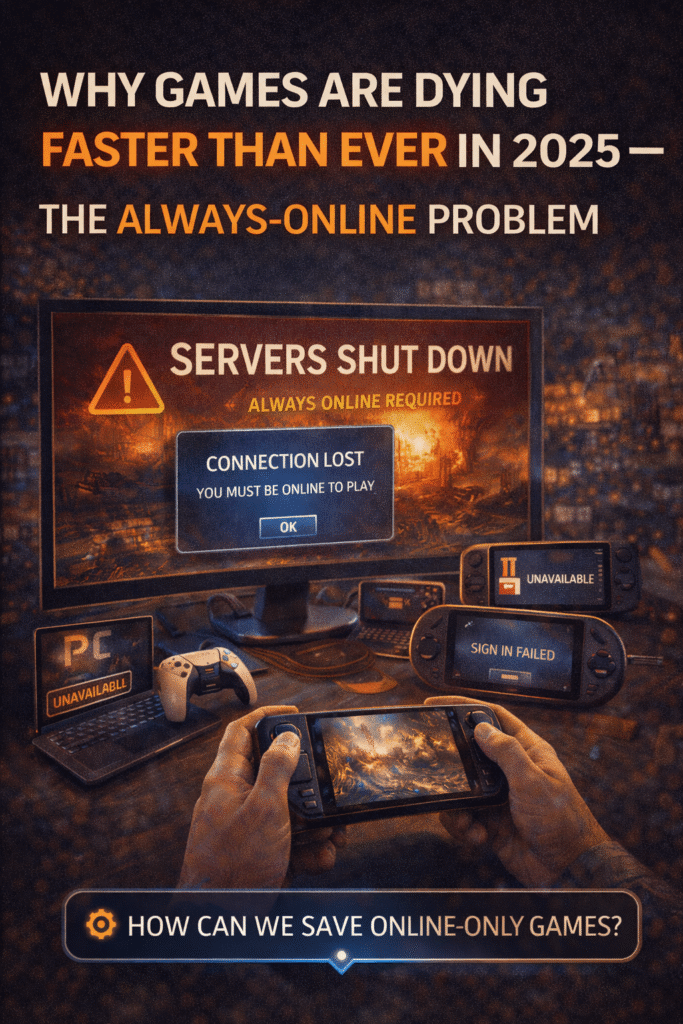
In 2025, buying a game no longer guarantees you can play it forever.
Servers go offline.
Accounts stop working.
Games disappear — even from libraries you paid for.
More players are realizing an uncomfortable truth:
Modern games don’t just get outdated — they get shut down.
🌐 What “Always-Online” Really Means
An always-online game requires a constant internet connection — even for single-player modes.
Why developers use it:
online progression tracking
anti-cheat systems
live events and updates
monetization and analytics
But this dependence comes at a cost.
If the server goes down, the game dies.
⚠️ Why Games Are Shutting Down So Quickly
Games aren’t lasting decades anymore. Some barely survive a few years.
💰 Live Service Economics
Modern games rely on:
battle passes
seasonal content
cosmetic stores
recurring spending
If players leave, servers are no longer profitable.
And when profits stop — support ends.
🧠 Backend Technology Is Expensive
Running a live game means maintaining:
servers
databases
security updates
cloud infrastructure
Even popular games can be shut down if long-term costs outweigh revenue.
📉 Player Attention Is Shorter
With thousands of games competing for attention:
players move on faster
communities fragment
older titles lose relevance
This accelerates shutdown decisions.
🎮 How This Affects PC, Console, and Mobile Gamers
The impact is everywhere.
On PC:
always-online DRM blocks offline play
abandoned games become unlaunchable
On consoles:
games vanish from digital stores
servers shut down without refunds
On mobile:
games disappear overnight
progress is lost permanently
Ownership is turning into temporary access.
🏆 Esports and Competitive Games Are at Risk Too
Competitive titles rely entirely on servers.
When servers shut down:
rankings disappear
replays are lost
competitive history vanishes
Entire esports scenes have collapsed overnight due to backend shutdowns.
😡 Why Gamers Are Pushing Back in 2025
This topic is trending because players are angry.
Common frustrations include:
games becoming unplayable after purchase
lack of offline modes
no long-term preservation
loss of personal progress
Online communities are now demanding:
offline fallbacks
end-of-life modes
server emulation tools
The debate is growing louder.
🛠️ Technologies That Could Save Games
Developers are exploring solutions.
🔓 Offline Unlock Patches
Before shutdown, games could receive:
full offline functionality
local save support
server-free modes
Some studios have started experimenting with this.
🧩 Community-Hosted Servers
Allowing players to host:
private servers
local multiplayer
modded backends
This extends game life indefinitely.
☁️ Hybrid Online-Offline Architecture
Games keep online features —
but core gameplay runs locally.
If servers go down, the game survives.
🔮 What the Future Looks Like
In the next few years, we may see:
laws protecting digital ownership
mandatory offline modes
open-source server releases
stronger preservation efforts
Gaming is entering a phase where longevity matters.
🏁 Final Thoughts
The biggest threat to gaming in 2025 isn’t graphics limits or hardware costs.
It’s impermanence.
A great game shouldn’t disappear because a server bill wasn’t paid.
As technology evolves, gamers are demanding one thing clearly:
If we buy a game — it should live on.
And that conversation is only getting louder.


