

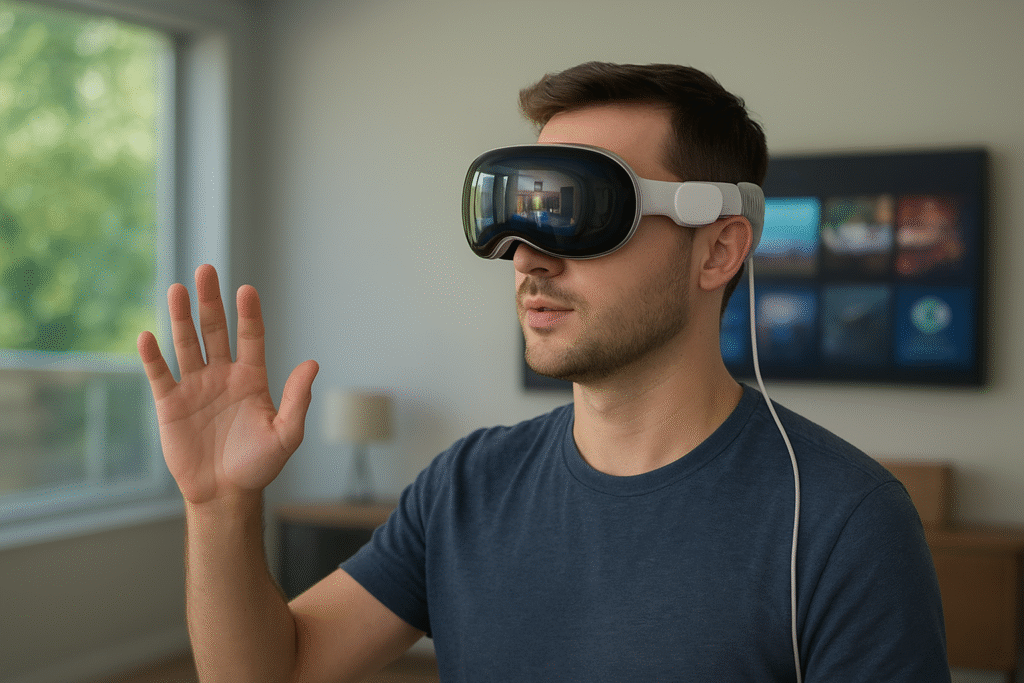
Just when we thought smartphones had peaked, Apple dropped something that changed the game — the Vision Pro.
More than just a headset, it’s the beginning of a new era: spatial computing — where digital content doesn’t just appear on screens, but lives around you.
In 2025, spatial computing is becoming the next big frontier of technology, blending AR, VR, and AI into one seamless experience that’s transforming how we work, learn, and play.
🌍 What Is Spatial Computing?
Spatial computing is the next evolution of digital interaction — it lets technology understand and respond to the physical world.
Instead of tapping on screens, you look, gesture, and speak to control your environment.
Imagine opening your laptop, except there’s no laptop.
You just put on a lightweight headset, and your entire workspace floats around you — browsers, chat windows, music, and even your favorite coffee shop background.
This is not science fiction anymore.
It’s the Vision Pro reality.
💼 Work Without Screens
In 2025, professionals are starting to ditch traditional monitors for virtual screens powered by Apple Vision Pro and Meta Quest 3.
Designers can drag 3D models around their room.
Developers can code on floating windows while watching tutorials on another virtual display.
Meetings happen in 3D spaces where your colleagues’ avatars look almost human.
Even better — your workspace travels with you.
All you need is your headset and a quiet corner.
🎬 Entertainment Reimagined
Movies and games are the heart of spatial computing.
Watching a film on Vision Pro feels like sitting in a personal IMAX theater — you can resize, reposition, or even step inside the scene.
Gaming has taken it to another level:
- Racing games let you steer virtual cars in your living room.
- Adventure titles place dragons and enemies in your real environment.
- AR concerts bring your favorite artists into your bedroom — literally.
Even Netflix and Disney+ have started releasing spatial-first content, designed specifically for immersive environments.
🧠 The AI + Spatial Revolution
The true power of spatial computing comes alive when combined with AI.
AI agents can now appear as lifelike 3D companions, guiding you through tasks, learning your habits, and helping you in real time.
For example:
- A personal AI trainer can appear beside you, correcting your workout posture.
- A 3D assistant can show you how to fix your car engine using real-time overlays.
- In classrooms, students can interact with 3D holographic lessons — like dissecting a virtual frog or exploring Mars.
It’s learning and productivity reimagined.
🏠 The Smart Home Goes Spatial
Your home is no longer just “smart.” It’s aware.
Using Vision Pro or similar headsets, users can visualize their smart home data in 3D:
- See air quality or energy usage as visual graphs floating in your space.
- Control lighting and temperature with simple gestures.
- Overlay navigation arrows in your actual house for voice-controlled tasks.
Apple’s ecosystem connects seamlessly with HomeKit, Siri, and AI models — creating a world that reacts to you, not the other way around.
🚀 The Market Boom
The spatial computing market is expected to hit $300 billion by 2030, with Apple leading the race.
Tech giants like Meta, Samsung, and Google are racing to build their own ecosystems.
Startups are popping up everywhere — building spatial browsers, 3D productivity apps, and immersive storytelling platforms.
And just like the App Store boom in 2008, early developers in spatial computing are already making millions.
⚠️ Challenges Ahead
Of course, not everything is perfect:
- The price of devices like Vision Pro keeps them out of reach for many.
- Battery life and comfort are still work-in-progress.
- And privacy concerns are growing — spatial computing captures detailed environmental data that must be handled carefully.
But as technology improves, these barriers are fading fast.
🔮 The Future: Beyond Headsets
By 2030, experts predict we’ll move from bulky headsets to lightweight AR glasses — or even contact lenses — capable of full spatial interaction.
This will blur the lines between real and digital life completely.
Imagine walking down the street, and your AR glasses automatically translate street signs, highlight restaurants with good reviews, or project navigation arrows on the road.
That’s the future spatial computing promises — a world where information blends naturally with your surroundings.
🏁 Final Thoughts
The age of flat screens is ending.
Spatial computing is here — not as a gadget, but as the next platform for human experience.
Just like the iPhone changed how we connect, Vision Pro and its successors are changing how we see.
In 2025, your world isn’t just on a screen — it’s around you.
And that’s the kind of innovation that doesn’t just trend — it transforms.


