

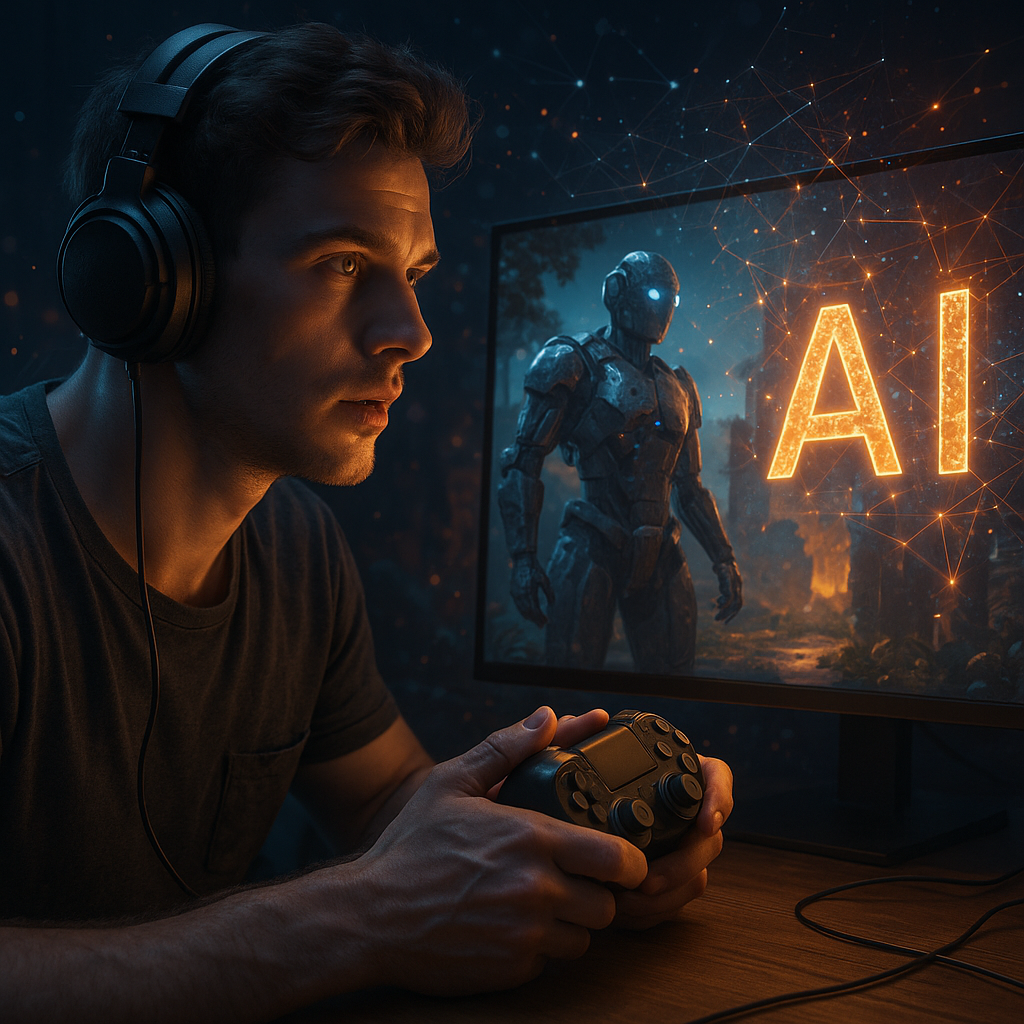
The year is 2025 — and artificial intelligence isn’t just behind the scenes anymore.
It’s inside the game, shaping every interaction, story, and challenge in real time.
From NPCs (non-player characters) that remember your past actions to entire worlds that evolve based on your play style, AI-driven gaming is changing what it means to “play” a video game.
This is more than a tech upgrade — it’s the beginning of living, breathing virtual worlds.
🎮 From Pre-Scripted to Intelligent Worlds
For decades, games followed fixed scripts.
NPCs repeated the same lines, made predictable choices, and never truly “understood” you.
But in 2025, thanks to massive advances in generative AI, machine learning, and neural NPCs, developers are building dynamic worlds where no two players experience the same story.
Imagine walking into a fantasy tavern where every character has a unique personality, voice, and memory of your past actions. They remember if you betrayed them, helped them, or ignored them.
That’s not a cutscene — that’s AI.
🧠 AI NPCs: The New Co-Stars of Gaming
Companies like Ubisoft, Nvidia, and Inworld AI are leading a new frontier:
- NPCs now respond naturally to speech, not just pre-set dialogues.
- They learn from interactions, developing emotions and loyalties.
- Some even use AI-generated voices and procedural backstories that evolve over time.
For example, in a futuristic RPG, a guard you spare early in the game might return hours later — not because the script says so, but because the AI decided he wants to repay you.
It’s storytelling powered by intelligence, not code.
🌍 AI Worldbuilding: Games That Evolve
AI isn’t just limited to characters — it’s building the world itself.
Game engines like Unreal Engine 5.3 and Unity Muse use AI to:
- Generate environments dynamically (cities, forests, dungeons).
- Adapt difficulty based on your skill level.
- Create side quests that feel handcrafted.
Every session can feel like a new adventure — endless replayability without the grind.
Developers no longer have to manually design every asset or event; AI does the heavy lifting, freeing them to focus on creativity and storytelling.
🎨 The Rise of Personalized Experiences
AI makes games deeply personal.
In traditional games, every player experiences the same missions and cutscenes.
Now, the game can tailor itself to you.
If you’re aggressive, AI can make enemies adapt to your tactics.
If you’re curious, new hidden paths may open.
If you like storylines with romance or mystery, the AI can build entire quests around those preferences.
No two playthroughs will ever be alike.
💬 Voice, Emotion, and Real Conversations
AI voice synthesis and emotion recognition are unlocking real conversations with NPCs.
Players can now speak naturally — not select from dialogue trees — and the AI understands, reacts, and responds contextually.
Games like Project Electric Sheep, AltCtrlVerse, and Neural Odyssey are experimenting with voice-based gameplay, where your tone, hesitation, or confidence can alter the story’s outcome.
You’re no longer playing a story — you’re living it.
⚡ Challenges & Ethics
Like all new technology, AI gaming raises questions:
- Data & privacy: AI learns from players — but what data should it keep?
- Ethics: How real should virtual characters feel?
- Balance: Will AI make games too unpredictable or too easy?
Developers are working on “ethical AI frameworks” to ensure fair, safe, and transparent gaming experiences.
But one thing’s clear — there’s no going back.
🚀 The Future of AI Gaming
By 2027, analysts predict that over 60% of major game titles will include generative AI features — whether for storytelling, voice, or adaptive design.
This isn’t just about better graphics anymore — it’s about intelligence.
Games are becoming living worlds that think, feel, and grow alongside the player.
Soon, you won’t just play a character.
You’ll co-create the world with AI.
🏁 Conclusion
Artificial intelligence is turning video games into something entirely new — a space where imagination meets computation.
Every dialogue, mission, and emotion can now evolve based on how you play.
Games are no longer written — they’re experienced dynamically.
And as AI continues to blur the line between human creativity and digital intelligence, one thing’s certain:
🎮 The future of gaming isn’t just interactive. It’s alive.


