

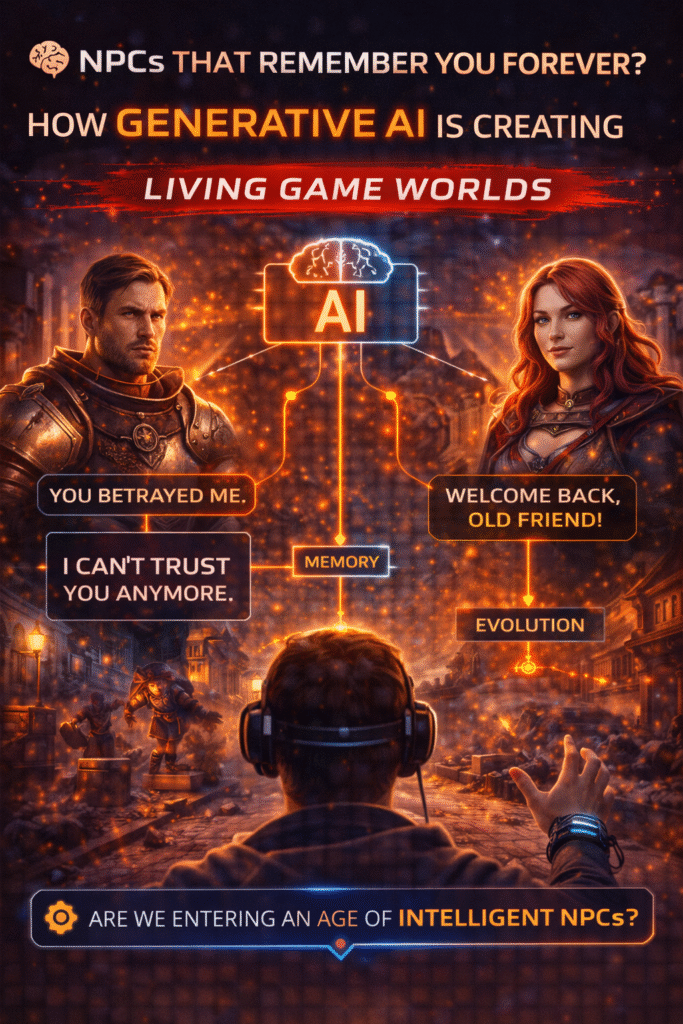
For decades, NPCs followed scripts.
You talk.
They repeat.
You finish quest.
They reset.
But that era is ending.
Thanks to generative AI, NPCs are evolving into persistent digital personalities that remember your choices, adapt to your behavior, and evolve over time.
And it might completely transform gaming.
🤖 The Rise of AI-Powered NPCs
Studios are now experimenting with AI-driven characters using large language models similar to:
- OpenAI
- NVIDIA
These systems allow characters to:
- Hold dynamic, unscripted conversations
- Remember past interactions
- Develop opinions about the player
- React emotionally to decisions
This isn’t pre-written dialogue.
It’s real-time generation.
🎮 What This Means for Players
Imagine this:
You betray an ally early in the game.
Weeks later, another character references your reputation.
Shops increase prices.
Guards treat you differently.
Former allies avoid you.
Not because it was scripted.
Because the AI remembered.
Now the game world feels alive.
🌍 Persistent Memory Changes Everything
Traditional games reset behavior after missions.
AI-driven worlds can:
- Track your moral alignment
- Record your negotiation style
- Learn your combat patterns
- Adapt future storylines dynamically
That means:
No two playthroughs are truly identical.
And spoilers lose power.
🔥 Why This Can Go Viral
Because it changes storytelling.
Gamers love sharing:
- “This NPC roasted me for stealing earlier.”
- “My AI companion left because I kept choosing violent paths.”
- “The villain referenced something I said 10 hours ago.”
It creates personalized viral moments.
Every player has a unique story.
🧠 The Tech Behind It
Modern AI NPC systems use:
- Memory embedding databases
- Real-time dialogue generation
- Emotion modeling
- Behavior prediction systems
- Cloud-based processing
Companies like NVIDIA are already showcasing AI digital humans capable of lifelike interactions.
It’s not sci-fi anymore.
⚖️ The Ethical Questions
With persistent AI characters come big concerns:
- Can NPCs manipulate players emotionally?
- Should AI characters simulate real trauma?
- Who controls long-term data memory?
- Can AI-generated dialogue cross safety boundaries?
As worlds become more intelligent…
They also become more complex ethically.
🕹️ Esports & Multiplayer Impact
Now imagine multiplayer games where:
- AI referees analyze behavior in real time
- AI commentators generate dynamic match narration
- AI spectators respond like real audiences
- AI anti-cheat systems adapt instantly
This tech isn’t limited to RPGs.
It could transform competitive gaming too.
🔮 The 5-Year Forecast
In the near future, we may see:
- AI companions with long-term memory across sequels
- Fully AI-generated side quests
- Living cities with autonomous NPC behavior
- Story arcs written dynamically during gameplay
Static scripts may become outdated.
Games could feel less like products…
And more like evolving ecosystems.
🏁 Final Thoughts
For decades, graphics defined immersion.
Then physics engines raised the bar.
But intelligence?
That’s the next frontier.
When characters remember you…
When they judge you…
When they adapt to you…
Gaming stops feeling programmed.
It starts feeling personal.
And that might be the biggest evolution yet.


