

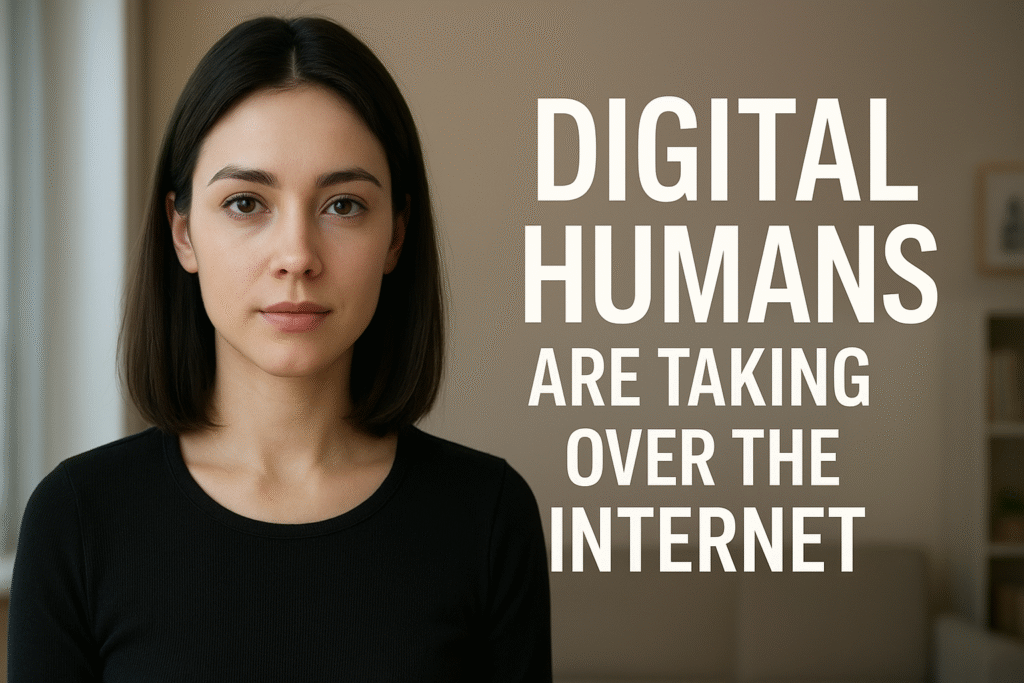
What if the next big influencer… isn’t even human?
Welcome to 2025 — the year AI-generated digital humans (also called AI clones, virtual influencers, or synthetic personalities) are exploding across social media, business, entertainment, and even customer service.
These digital humans look real, talk real, and behave like actual people — but they don’t exist.
And the internet can’t stop talking about them.
🤖 What Exactly Are Digital Humans?
Digital humans are ultra-realistic AI-generated avatars created using:
- Advanced deepfake technology
- Photorealistic 3D modeling
- Voice cloning
- Large AI models like GPT-5, Claude 4.2, LLaMA 4
- Motion capture & generative video models
The result:
A human-like AI that can speak, express emotions, and appear in videos 24/7.
📈 Why Are Digital Humans Going Viral Right Now?
1. Zero Camera, Zero Crew, Zero Cost
Businesses can now create:
- Influencers
- Customer service agents
- Teachers
- Fitness trainers
- Musicians
Without hiring real people or studios.
A digital human can make 100 videos per day without getting tired.
2. Big Brands Are Already Using Them
Companies in 2025 using AI humans:
- Nike → AI fitness coaches
- Zara → AI models showing outfits
- Netflix → AI-generated hosts
- Samsung → AI customer support
- Starbucks → AI barista assistant
It’s cheaper.
Faster.
Scalable worldwide.
3. Social Media Is Flooded With AI Influencers
Some AI influencers have:
- Millions of followers
- Paid brand deals
- Huge engagement
- Viral Reels & TikToks
And most viewers can’t even tell they aren’t real.
🎤 AI Clones of Real People Are Trending
People are cloning themselves to:
- Make content while they sleep
- Train an AI to respond to comments
- Create a robotic “digital twin”
- Automate their YouTube channel
- Create personalized gaming avatars
Influencers are now literally duplicating themselves.
🎮 Gaming & Metaverse Are Evolving
Games in 2025 use:
- AI NPCs that respond intelligently
- Real players’ clones in multiplayer
- Personalized storylines generated by AI
Gamers are calling this:
“The biggest evolution since online multiplayer.”
🛍️ E-commerce Is Changing Forever
Digital humans can:
- Try outfits in 3D
- Model shoes
- Explain product features
- Speak in any language
- Personalize recommendations
Shopping becomes interactive and human-like, but powered entirely by AI.
🧠 How Digital Humans Work Behind the Scenes
They use a combination of:
- Generative video models → for movement
- AI voice clones → for speech
- LLMs → for personality and conversation
- Real-time rendering engines → for realism
- Deep learning → for emotion and expression
This is the first time AI can handle:
- Talking
- Moving
- Thinking
- Expressing
All in one system.
🔥 The Internet Debate: Good or Dangerous?
Some love them:
- “AI helps creators work faster.”
- “Businesses can scale instantly.”
Others fear:
- Identity theft
- Fake news
- Job loss
- Deepfake misuse
But one thing is certain —
Digital humans aren’t going away.
🚀 The Future: Everyone Will Have a Personal AI Clone
By 2026–2027, experts predict:
- Every creator will have an AI version of themselves
- Virtual influencers will dominate ads
- Schools will use AI teachers
- Movies will use AI actors
- AI personalities will run entire companies
Your AI clone might:
- Attend meetings for you
- Reply to emails
- Create social media content
- Teach your skills to others
- Act like your assistant
We’re entering the era where the internet belongs to humans + their digital copies.
🏁 Final Thoughts
Digital humans represent the next massive shift in how we create content, run businesses, entertain audiences, and interact online.
In 2025, the line between real and AI-generated is fading fast.
And soon?
You may have trouble knowing if the person on your screen is alive… or simply generated by code.


