

For decades, we’ve used our fingers, voices, and gestures to control technology.
But what if you could type, play, or design — using only your mind?
Welcome to 2025 — the year Brain-Computer Interfaces (BCIs) went mainstream.
Once confined to sci-fi movies, this tech is now shaping gaming, healthcare, communication, and even daily life.
Companies like Neuralink, Synchron, and NextMind are leading the charge, bringing mind-control technology to reality.
🧩 What Exactly Is a Brain-Computer Interface?
A Brain-Computer Interface (BCI) is a system that connects your brain directly to a computer.
It translates the electrical signals your neurons produce into digital commands — no keyboard, mouse, or controller required.
Think of it as Wi-Fi for your brain.
When you imagine moving your hand, the device picks up that signal and sends it to a computer, which executes the action — like moving a cursor or controlling a drone.
It’s pure science magic, powered by neuroscience and AI.
🎮 Gaming with Your Mind: The Next Revolution
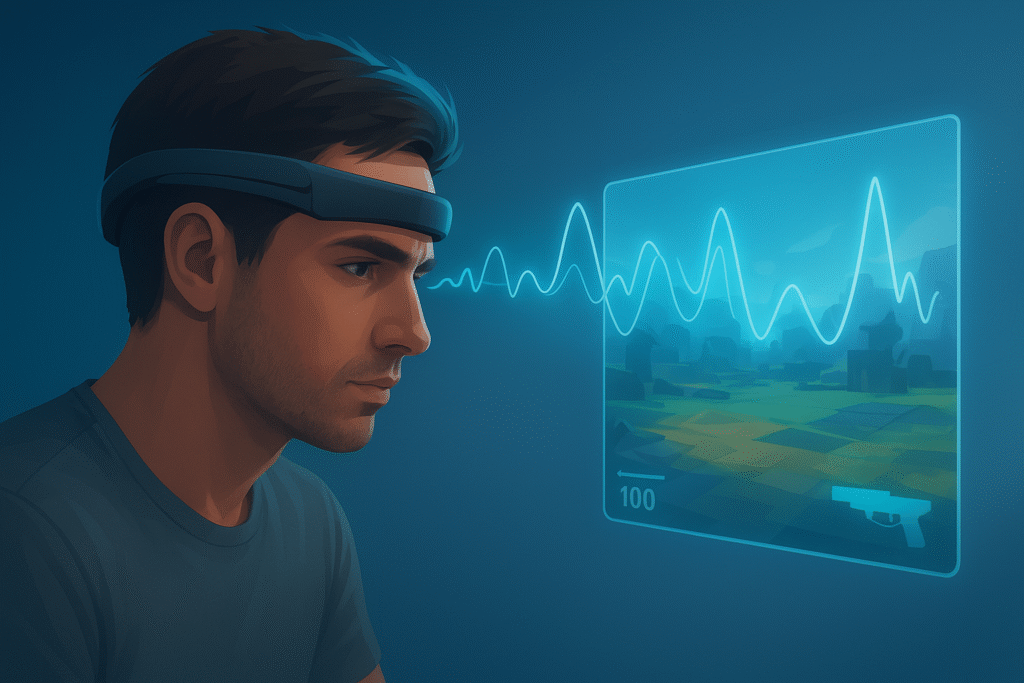
In 2025, gaming studios are experimenting with neural gameplay — letting players control characters through focus and thought.
Imagine:
- Reloading a gun in Call of Duty just by thinking “reload.”
- Casting spells in Elden Ring 2 through emotion-based triggers.
- Playing FIFA where your concentration literally determines precision.
Some gamers already use non-invasive BCI headbands that detect attention and emotional intensity to enhance gameplay or adjust difficulty in real time.
Mind-controlled gaming isn’t just futuristic — it’s here.
🏥 Medical Miracles with BCI
While gaming gets headlines, healthcare is where BCIs are making life-changing impact.
- Paralyzed patients can now move robotic arms, type messages, or control wheelchairs through thought alone.
- Memory restoration trials are underway for Alzheimer’s patients using neural implants.
- People suffering from ALS or spinal injuries can communicate again via thought-to-text systems.
Neuralink recently made history when a patient used an implant to play chess — using only his mind.
These breakthroughs are proving that BCIs aren’t just about tech; they’re about restoring humanity.
💬 Communication Without Words
Imagine sending a text without typing or saying a word — just thinking it.
BCIs are unlocking silent communication, allowing thoughts to be transmitted digitally in real time.
Researchers at Stanford University developed a system that lets users “type” up to 90 words per minute using only their brain activity.
Now, companies are building prototypes for neural messaging apps — think WhatsApp for your thoughts.
The implications are massive — from accessibility for disabled users to rethinking how humans connect.
🧠 The Role of AI
AI is the key that makes BCIs functional.
It decodes the complex electrical patterns of the brain and turns them into accurate digital actions.
Over time, AI learns your thought patterns — it understands you.
Your device can predict what you want before you fully think it, making interactions instantaneous.
It’s like having an invisible digital twin that knows your habits and adapts accordingly.
⚠️ The Ethical Questions
But this tech also raises tough questions:
- How do we protect mental privacy?
- Could companies one day read thoughts for ads or marketing?
- What happens if a hacker gets access to your neural data?
In 2025, lawmakers are already drafting “neuro-rights” — digital privacy laws specifically for the human brain.
Because once technology can read minds, the line between human and machine becomes very thin.
🚀 The Road Ahead
Experts predict that by 2030, lightweight, wireless BCIs could replace touchscreens and controllers altogether.
You’ll control your phone, car, or even smart home appliances with a simple thought.
Tech companies are also exploring neural AR glasses — allowing you to visualize apps, control interfaces, and play games directly through your neural activity.
In essence, your brain could become your new operating system.
🌟 The Future Is In Your Head
Brain-computer technology is no longer the future — it’s becoming the present.
From mind-controlled games to thought-to-text communication, we’re entering an age where the brain is the ultimate user interface.
It’s exciting, it’s controversial, and it’s unstoppable.
The next great leap in technology won’t come from faster chips or smarter phones —
It’ll come from you.


