

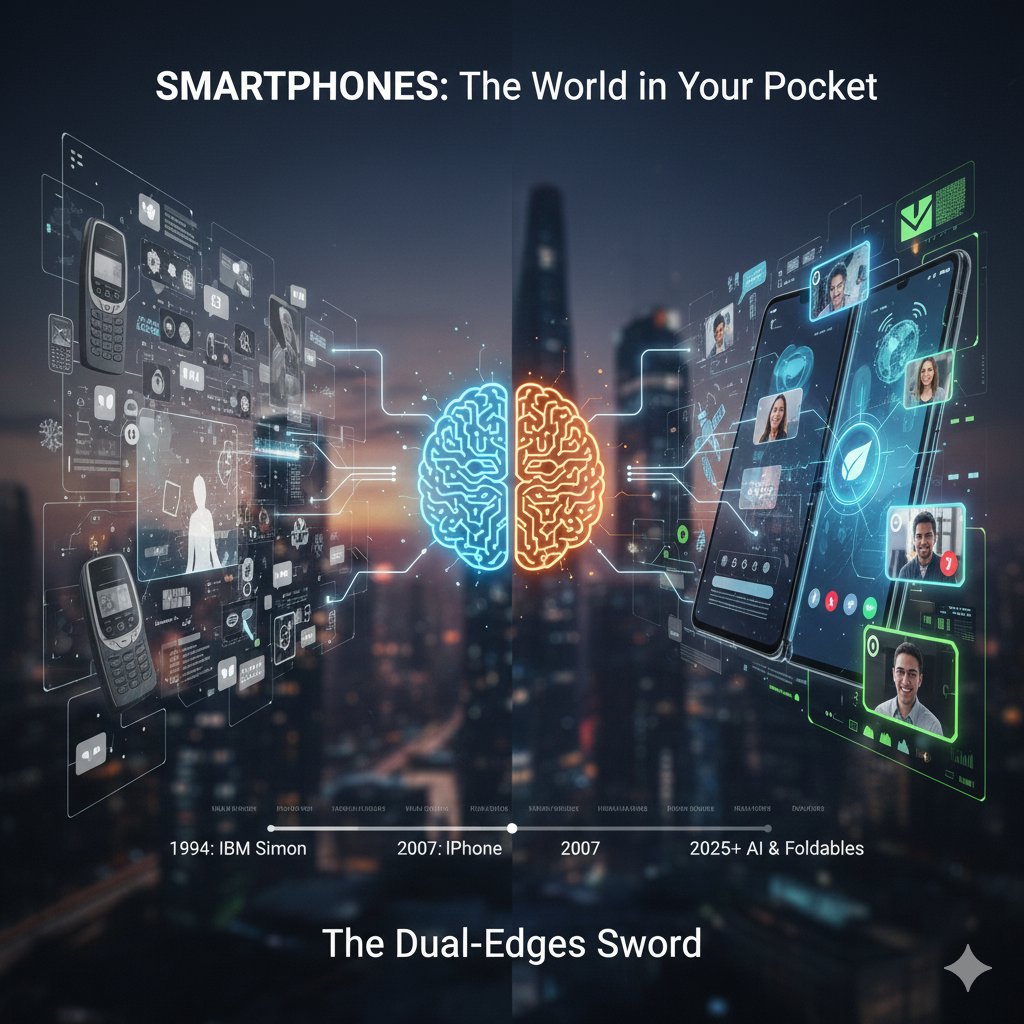
No single invention in the last century has integrated itself into the fabric of daily life quite like the smartphone. What began as a bulky business tool has evolved into a ubiquitous, ultra-powerful personal computer, camera, bank, navigation system, and communication hub—all condensed into a sleek, pocket-sized device. The smartphone is the anchor of the modern digital economy, and its evolution continues to redefine the boundaries of human-technology interaction.
A Brief History: From ‘Brick’ to Breakthrough
The journey of the smartphone is one of rapid miniaturization and exponential power gain:
- The Pioneers (1990s): The concept of a mobile device combining a phone and a Personal Digital Assistant (PDA) began with the IBM Simon Personal Communicator, released in 1994. It was the first commercial device to include a touchscreen, address book, and apps like a calculator, predating the term “smartphone.”
- The PDA Hybrids (Late 90s – Early 2000s): Companies like Nokia (with Symbian), Palm, and BlackBerry dominated the market, creating devices focused on business communication, email, and QWERTY keyboards.
- The Revolution (2007): Apple’s iPhone fundamentally reset the paradigm. It popularized the large capacitive touchscreen, abandoned the stylus/keypad in favor of direct finger input (multi-touch), and, most critically, introduced the centralized App Store. This created a developer ecosystem that unleashed the true power of mobile computing and shifted the market focus from business to the mass consumer.
- The Android Era (2008+): Google’s Android OS, an open-source alternative, quickly accelerated smartphone adoption globally, leading to the duopoly of iOS and Android that defines the market today.
The Current Landscape: Key Trends in 2025 and Beyond
Smartphones are no longer just devices; they are the primary interface for Artificial Intelligence (AI) and advanced connectivity. The major trends shaping the market today include:
1. The AI Integration Imperative
AI is moving from a novelty feature to the core operating system.
- On-Device AI (Edge Computing): New mobile processors are designed with powerful Neural Processing Units (NPUs) to run sophisticated AI models locally on the phone. This enables faster, more personalized experiences—from advanced photo editing and real-time translation to predictive battery management—all while keeping sensitive data private on the device.
- Contextual Intelligence: AI now learns user habits and emotions to adapt the phone’s interface and functions seamlessly, moving from reactive voice assistance to proactive digital “agents” that anticipate user needs.
2. The Form Factor Evolution: Foldables and Rollables
After years of the standard glass slab design, innovation is returning to hardware flexibility.
- Mainstream Foldables: Devices with improved, durable hinges and flexible OLED displays are gaining market share. They offer the portability of a phone and the expanded screen real estate of a tablet, greatly enhancing multitasking, gaming, and content consumption.
- Future Rollables: Devices with screens that can mechanically roll out to expand their size are emerging, promising even greater versatility for users who need adaptive displays.
3. Connectivity and Speed
The backbone of the smartphone experience continues to be speed and reliability.
- 5G Consolidation: 5G networks are fully established across major markets, enabling ultra-fast download speeds, lower latency for cloud gaming, and robust support for Augmented Reality (AR) applications.
- Satellite Connectivity: Once limited to high-end devices for emergency calls, satellite link-up capabilities are expanding to include basic texts and potentially even calls in areas without traditional cellular service, eliminating coverage gaps.
4. The Sustainability and Health Focus
Consumers and regulators are demanding more responsibility from manufacturers.
- Eco-Friendly Design: Manufacturers are increasingly using recycled materials (plastics, rare-earth metals) in production, adopting modular designs to facilitate repairs, and offering longer software support to reduce electronic waste.
- Integrated Health Monitoring: Smartphones are evolving into comprehensive health hubs, utilizing advanced sensors for real-time tracking of vital signs (heart rate, blood oxygen, potentially even glucose levels) and integrating deeply with telemedicine services.
The Profound Impact on Society (The Dual-Edged Sword)
The smartphone’s influence extends far beyond technology, fundamentally reshaping global culture, business, and individual psychology:
| Positive Impacts | Negative Impacts |
| Global Access to Information: Democratized access to education, news, and resources worldwide. | Addiction and Mental Health: Compulsive usage, increased anxiety, sleep disruption, and FOMO (Fear of Missing Out). |
| Economic Engines: Created the multi-trillion-dollar “App Economy,” revolutionizing retail, banking (Fintech), and transportation. | Privacy and Security Risks: Constant data collection by apps and platforms, and increased exposure to cyber threats (phishing, identity theft). |
| Enhanced Safety: Immediate access to emergency services, GPS navigation, and personal safety features. | Digital Divide: The gap between those with access to high-speed devices/networks and those without can exacerbate social inequality. |
| Social Connection: Maintained global family and social connections through instant messaging and video calls. | Reduced Social Interaction: Displacement of face-to-face interaction and potential for cyberbullying or social isolation. |
The smartphone remains the central technological artifact of our time. Its future hinges on balancing unprecedented AI power with robust privacy controls, continuous innovation with sustainable practices, and profound societal benefit with careful management of its potential for psychological harm.


