

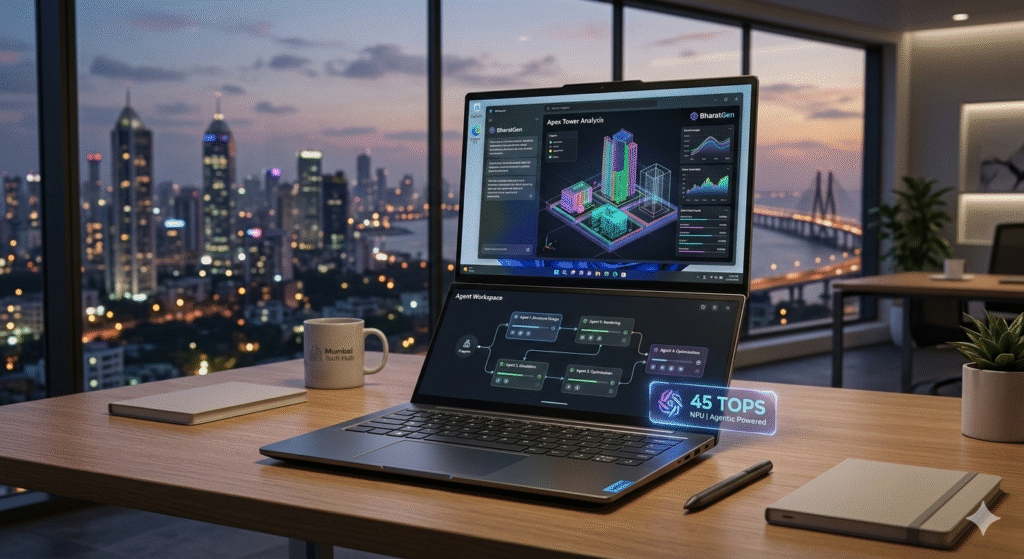
The desktop landscape has reached a point of “AI Absolutism.” If 2025 was about adding an AI button to your keyboard, 2026 is about rebuilding the entire operating system around the Neural Processing Unit (NPU). We are currently six months away from the expected launch of Windows 12 (Hudson Valley), and the hardware requirements are sparking the biggest PC upgrade cycle since the move to 64-bit.
Here is the state of the PC market as of late February 2026.
I. Windows 12: The “Hudson Valley” Countdown
Internal builds of Windows 12 (Germanium platform) have leaked into the Canary channel, revealing a modular, AI-first architecture.
- The Floating Taskbar: Microsoft has finally detached the taskbar from the bottom bezel. It now “floats” with rounded corners, similar to a dock, while a new Top Bar handles system status (clock, battery, notifications) to maximize screen real estate for AI agents.
- AI Explorer: This is the “Photographic Memory” feature we’ve been waiting for. Using 45+ TOPS of NPU power, it creates a local, searchable index of everything you’ve ever seen or done on your PC—without ever sending data to the cloud.+1
- CorePC Architecture: Windows is moving to “State Separation.” The OS files are now in a read-only partition, making updates nearly instant and rendering traditional malware almost impossible to install.+1
II. The Silicon Wars: X2 vs. Panther Lake vs. Strix
The fight for the “Most Efficient AI PC” has moved to a three-way battle.
- Qualcomm’s Gaming Flex: The new Snapdragon X2 Elite Extreme just dropped benchmarks showing it can run 90% of Windows games at 1080p/60fps natively, thanks to its Adreno X2 iGPU which is 50% faster than last year’s Lunar Lake.
- Intel’s Panther Lake: Early “Core Ultra Series 3” (Panther Lake) samples are circulating in labs. Intel claims their new 50 TOPS NPU will be the gold standard for “System 2” reasoning, prioritizing complex math and coding over simple text generation.
- AMD’s AI Supremacy: The Ryzen AI 400 series continues to lead in multi-threaded performance, making it the preferred choice for local LLM (Large Language Model) developers who need high memory bandwidth.
📊 Indian Laptop Market Pulse: February 2026
| Model | Processor | India Price (Est.) | Key “Agentic” Feature |
| Lenovo ThinkBook Plus G7 | Intel Core Ultra 3 | ₹1,45,000 | Auto Twist: Screen rotates to track your face during calls. |
| Dell XPS 16 (2026) | Intel Panther Lake | ₹1,95,000 | Zero-Lattice Keyboard: Haptic feedback tailored to AI typing aid. |
| HP OmniBook Ultra 14 | Snapdragon X2 Elite | ₹1,15,000 | 85 TOPS NPU: Can run local models up to 14B parameters. |
| MSI Prestige 16 AI | Intel Core Ultra 2 | ₹89,990 | Pro-Grade Noise Cut: AI isolation for busy office environments. |
| Acer Swift Go 14 | AMD Ryzen AI 300 | ₹68,000 | Auto SR 2.0: Real-time 4K upscaling for all video content. |
III. The “Great AI Upgrade” Backlash
The hardware floor has officially moved.
- 16GB is the New 8GB: Microsoft has confirmed that Windows 12’s flagship AI features will require 16GB of LPDDR5X RAM as a minimum. This has effectively “obsoleted” millions of 8GB laptops sold just 18 months ago.
- The NPU Gate: While Windows 12 will run on older chips, features like Auto Super Resolution 2.0 and Real-time Live Captions will be hardware-locked to NPUs with 45+ TOPS.
- India Context: In response, Indian retailers are seeing a massive surge in “NPU Trade-in” programs, where users can swap 2024-era laptops for 2026 AI PCs with aggressive financing.
The Big Takeaway: The “PC” is becoming an “APC” (Agentic Personal Computer). We are moving away from a tool that waits for your input to a partner that indexes your intentions. If your laptop doesn’t have an NPU sticker on it today, it won’t be able to “think” with you tomorrow.


