

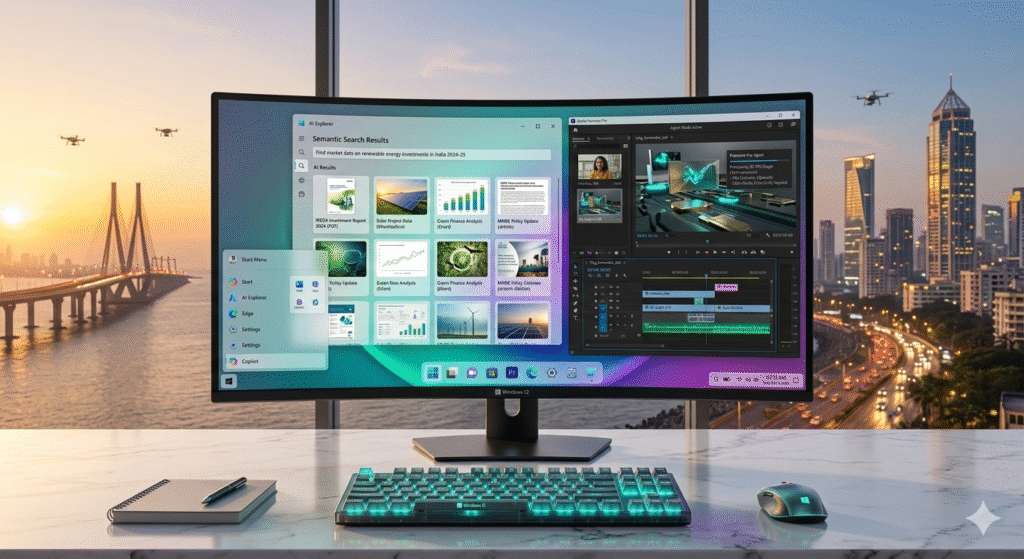
If you’ve spent the morning cleaning up your desktop icons, you’re officially a “legacy user.” In 2026, we don’t manage files; we manage Agents. The software on your PC has transitioned from being a passive tool to an active partner that indexes your intentions before you even click.
Here is your intelligence briefing on the desktop software landscape as of Wednesday, March 4, 2026.
I. The “Hudson Valley” Reality: Windows 12 Preview
Microsoft’s Project Hudson Valley (the internal codename for the next-gen Windows) has officially hit the Release Preview channel this week.
- The Floating Shell: The most jarring change is the “Floating Taskbar.” It no longer sits on the bezel but hovers like a dock, while the system tray has moved to a dedicated “Status Bar” at the top of the screen—maximizing vertical space for AI-driven workspaces.
- Semantic Search 2.0: Thanks to the 45 TOPS NPU mandate, Windows now performs “Semantic Indexing” of everything you do. You can ask, “Where is that chart I saw on a website about carbon tax three days ago?” and it pulls up the exact pixel-perfect snapshot of that moment.
- CorePC Architecture: This is the big one. Windows is now modular. If you have a high-end gaming rig, you get the full “Enthusiast” state; if you’re on a thin-and-light, the OS sheds 15GB of “bloat” and runs a streamlined AI-first core.
II. Adobe’s “Creative Agents”: From Gen to Exec
Adobe MAX 2026 previews suggest that the company is moving beyond “Generative Fill” to “Agentic Workflows.”
- The Firefly Foundry: Adobe has integrated its Firefly 4.0 agents into Creative Cloud. You can now prompt, “Take this 10-minute vlog, edit it down to a 60-second vertical short with captions in Hindi, and match the color grade to a ‘cyberpunk’ aesthetic.” The agent doesn’t just suggest edits; it performs the timeline cuts.
- WPP Open Integration: A massive partnership between Adobe and WPP was finalized yesterday, bringing BharatGen-certified brand safety agents to Indian enterprise users, ensuring that AI-generated marketing content is culturally and legally compliant in local markets.
Desktop Software Pulse: March 2026
| Software Category | 2024 (Passive) | 2026 (Agentic) | Key Release This Week |
| Operating System | Windows 11 (Copilot sidebar) | Windows 12 (CorePC Architecture) | Build 27000 (Canary) |
| IDEs / Coding | Autocomplete (Copilot) | Repo-Aware Agents (Composer) | Cursor “Ultra” |
| Creative Suite | Generative Fill / Text-to-Image | Multi-step Execution Agents | Adobe Firefly Foundry |
| Browsers | Ad-blockers & Tab Groups | Site Interaction Agents | Arc Max 2.0 |
| Productivity | Cloud-based SaaS | Local-First (NPU-Powered) | Anytype Desktop v2 |
III. The Developer War: Zed vs. Cursor
The “Editor War” has a new front line.
- Cursor AI: Currently the “Gold Standard” for deep automation. Its Composer agent can now handle multi-file refactors and open Pull Requests autonomously.
- Zed (Rust-Powered): Zed has launched the Agent Client Protocol (ACP) this morning. Unlike Cursor, which is tied to its own model, Zed aims to be “Switzerland”—allowing you to plug in any agent (Claude Code, OpenAI Operator, or a local Llama 4) into its blazing-fast, GPU-accelerated interface.
IV. The “Local-First” Revolution
Privacy concerns and the ubiquity of NPUs have sparked a massive shift away from pure SaaS.
- The End of Latency: Apps like Anytype and Logseq are seeing 400% growth. Because your data lives on your 2TB SSD and is indexed by your local NPU, searches are instantaneous and work perfectly on a Mumbai-Delhi flight without Wi-Fi.
- Zero-Cloud Leakage: For Indian government and enterprise sectors, “BharatGen Local” is becoming the mandate. Software must now demonstrate it can perform 90% of its AI tasks without sending a single packet to a server.


