

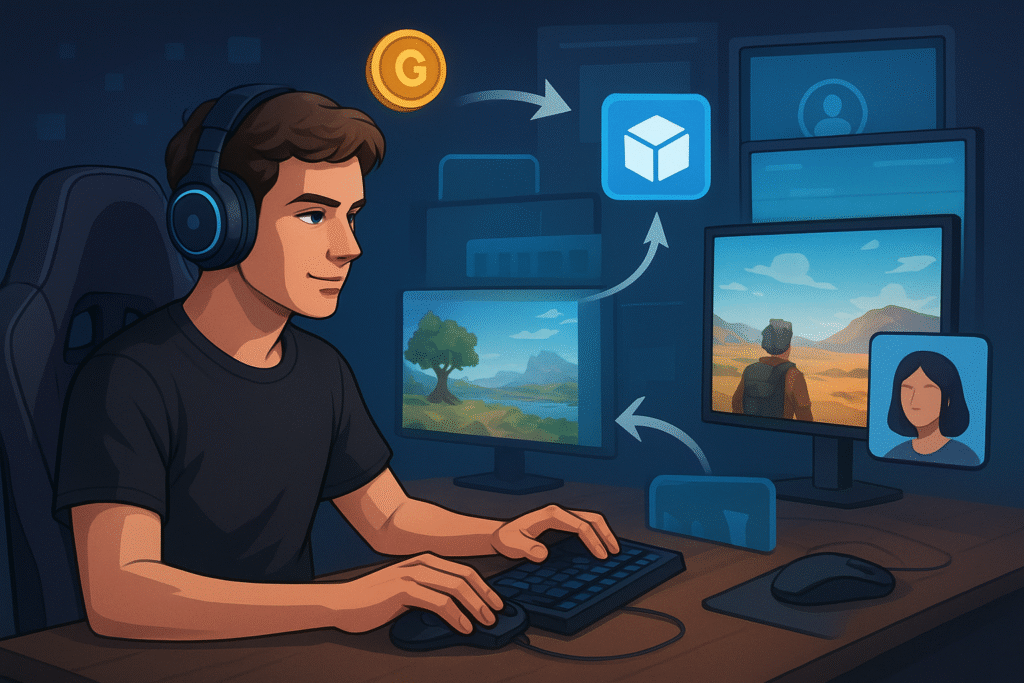
In 2025, gamers no longer care about which console, PC, or mobile device they own — because the next generation of gaming is borderless.
Thanks to cross-platform universes, blockchain technology, and digital ownership, players can now carry their progress, skins, items, and even entire identities across multiple games and ecosystems.
It’s not just “play anywhere.” It’s live anywhere — in a connected digital world.
The Cross-Platform Revolution
The walls between PlayStation, Xbox, PC, and mobile are crumbling fast.
For years, players were locked into specific ecosystems — achievements, purchases, and game progress tied to one device. But that’s changing.
Today, major developers like Epic Games, Ubisoft, and Microsoft are building shared gaming universes that connect multiple titles and devices through the cloud.
Imagine starting a mission on your PlayStation, continuing it on your phone during a commute, and finishing it on your gaming PC — with zero interruption.
Games like Fortnite, Call of Duty: Warzone Mobile, and Minecraft Realms are pioneering this seamless ecosystem, where your gamer identity travels with you, not your console.
Enter Blockchain and Digital Ownership
Behind the scenes, blockchain technology is powering a new layer of gaming — true digital ownership.
For the first time, players can own:
- Skins, weapons, and collectibles that are verifiable assets.
- Achievements stored permanently on-chain.
- Characters and avatars that persist across multiple worlds.
These aren’t the old “NFT hype” models of 2021 — 2025’s NFT 2.0 era is about utility and interoperability, not speculation.
When you buy a rare weapon in a Ubisoft game, you might also use it in another studio’s title through a shared blockchain standard like Open Meta Protocol (OMP).
It’s the closest gaming has ever come to a truly connected metaverse.
How Developers Benefit
For developers, this technology opens huge creative possibilities:
- Shared economies that link multiple games.
- AI-driven player identity tracking (while maintaining privacy).
- Cross-title storytelling that rewards loyal players.
Imagine earning a unique weapon in Assassin’s Creed and having it recognized in Fortnite or Cyberpunk 2077. That’s not a dream — it’s being tested right now.
Studios are already experimenting with “metagame loyalty systems” — points, badges, or NFTs that reward players across games and devices.
eSports & Competitive Gaming: A Unified Ecosystem
Cross-platform universes are transforming eSports too.
Tournaments in 2025 are becoming multi-device battles, where competitors can join from any setup — console, PC, or even high-end smartphones.
Blockchain ensures fair verification of scores, anti-cheat protection, and transparent prize distribution.
The future of eSports might not be one game at a time — it could be connected, multi-world championships that merge experiences like Valorant, Apex Legends, and PUBG into one ongoing metaverse leaderboard.
Challenges Ahead
This revolution isn’t without hurdles:
- Data privacy and wallet security remain major concerns.
- Compatibility between game engines is still evolving.
- Some players still fear “pay-to-own” models might return.
But with stronger regulation, transparent ownership systems, and decentralized verification, cross-platform gaming is becoming safer and more inclusive every year.
The Future of Play: A Unified Digital Identity
Soon, your gamer tag won’t just be a username — it’ll be a universal passport across worlds.
You’ll own your avatar, achievements, and memories.
Your virtual home will travel with you.
Your favorite games will become one continuous, evolving story.
2025 marks the start of gaming without borders — a world where technology connects, rather than divides, every player.
Final Thoughts
The next generation of gaming isn’t about buying the best console or graphics card — it’s about freedom.
Freedom to play, share, own, and express yourself across every platform.
Freedom to control your digital assets, your data, and your identity.
As blockchain and cross-platform ecosystems mature, gaming is no longer a pastime — it’s becoming a persistent, interconnected universe.
Welcome to the future of play — where every world is yours.


