

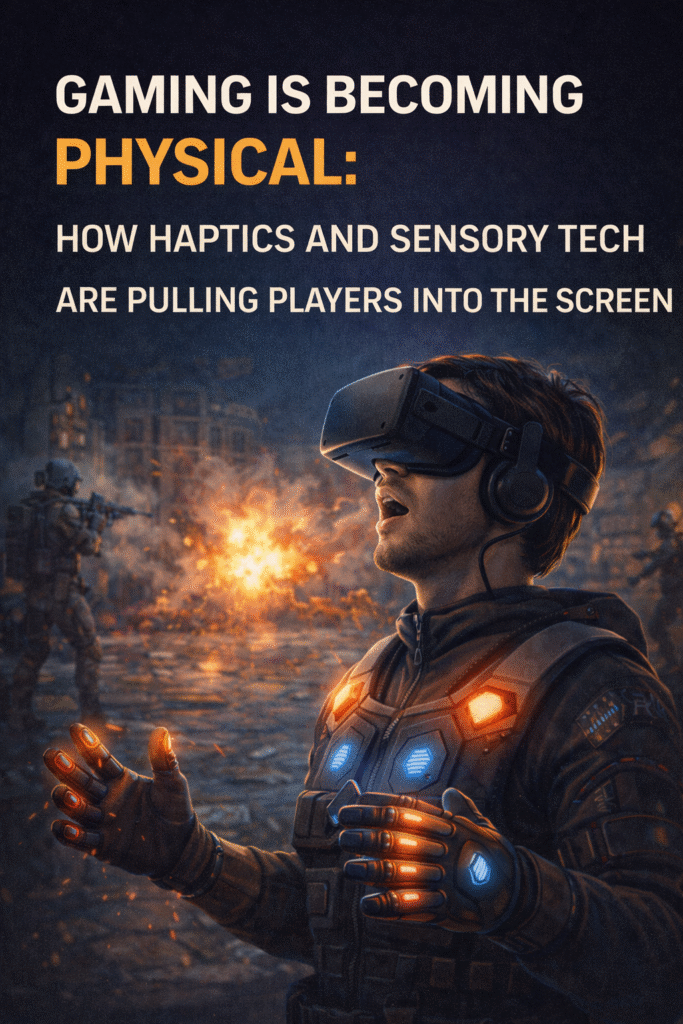
For decades, gaming has been something you watch and control.
In 2025, that boundary is breaking.
Games are no longer limited to visuals and sound. Thanks to rapid advances in haptic technology and sensory hardware, gaming is becoming something you feel — physically.
This shift is one of the most exciting and viral trends shaping the future of PC, console, mobile, and VR gaming.
🖐️ What Is Sensory Gaming?
Sensory gaming uses hardware that stimulates physical sensations during gameplay.
This includes:
- vibration and force feedback
- pressure and resistance
- temperature simulation
- directional touch
- full-body feedback
Instead of just seeing an explosion, you feel its impact.
Instead of hearing rain, you sense it across your body.
The player is no longer outside the game — they are inside it.
⚙️ Why This Technology Is Exploding in 2025
Three major breakthroughs pushed sensory gaming into the spotlight.
First, haptic motors became smaller, faster, and far more precise. Modern devices can simulate subtle sensations like footsteps, heartbeat, or recoil.
Second, game engines now support advanced haptic APIs, allowing developers to sync physical feedback directly with in-game events.
Third, VR and mixed-reality gaming created demand for deeper immersion. Visual realism alone was no longer enough.
Touch became the missing piece.
🎮 How PC and Console Gaming Are Using Haptics
On consoles and PC, haptics have gone beyond basic vibration.
Modern controllers and accessories can:
- change trigger resistance for different weapons
- simulate terrain through micro-feedback
- adjust feedback intensity based on stamina or damage
Games feel heavier, faster, and more realistic — not because of graphics, but because of physical response.
This tech is especially popular in shooters, racing games, and action RPGs.
📱 Mobile Gaming Quietly Joined the Sensory Revolution
Mobile gaming already had one advantage: direct contact.
In 2025, smartphones use:
- advanced vibration patterns
- touch-pressure sensitivity
- adaptive haptics
Mobile games now communicate danger, rewards, and rhythm through touch alone.
This helps mobile games feel more immersive without expensive hardware — one reason they continue to dominate player numbers.
🥽 Full-Body Haptics and VR: The Next Frontier
The most futuristic leap is happening in VR.
Haptic vests, gloves, and suits allow players to:
- feel impacts from any direction
- sense proximity and movement
- experience recoil, wind, or collisions
In competitive VR games, positioning and awareness now involve the entire body.
This is changing how players train, compete, and even exercise while gaming.
🏆 What This Means for eSports and Competitive Play
Physical feedback introduces a new dimension to competition.
Players must manage:
- physical endurance
- sensory overload
- muscle memory beyond fingers
Training now includes reaction conditioning and body awareness — not just reflex speed.
Future esports may reward players who can stay calm and accurate under intense physical feedback.
⚠️ The Challenges Nobody Is Ignoring
This trend is viral partly because it raises concerns.
Gamers are debating:
- motion sickness and fatigue
- accessibility for all players
- hardware costs
- competitive fairness
Not every player wants games to feel this intense — and developers must balance immersion with comfort.
🔮 Where Sensory Gaming Is Headed
In the coming years, we may see:
- lightweight full-body haptic gear
- shared sensory experiences in multiplayer
- horror games driven by touch and tension
- training games that simulate real-world conditions
- accessibility features that use haptics instead of visuals
Gaming won’t just entertain.
It will stimulate.
🏁 Final Thoughts
The future of gaming isn’t just higher resolution or faster frame rates.
It’s about presence.
When games can touch you back, immersion reaches an entirely new level.
The question gamers will soon ask won’t be:
“How real does this look?”
It will be:
“How real does this feel?”


