

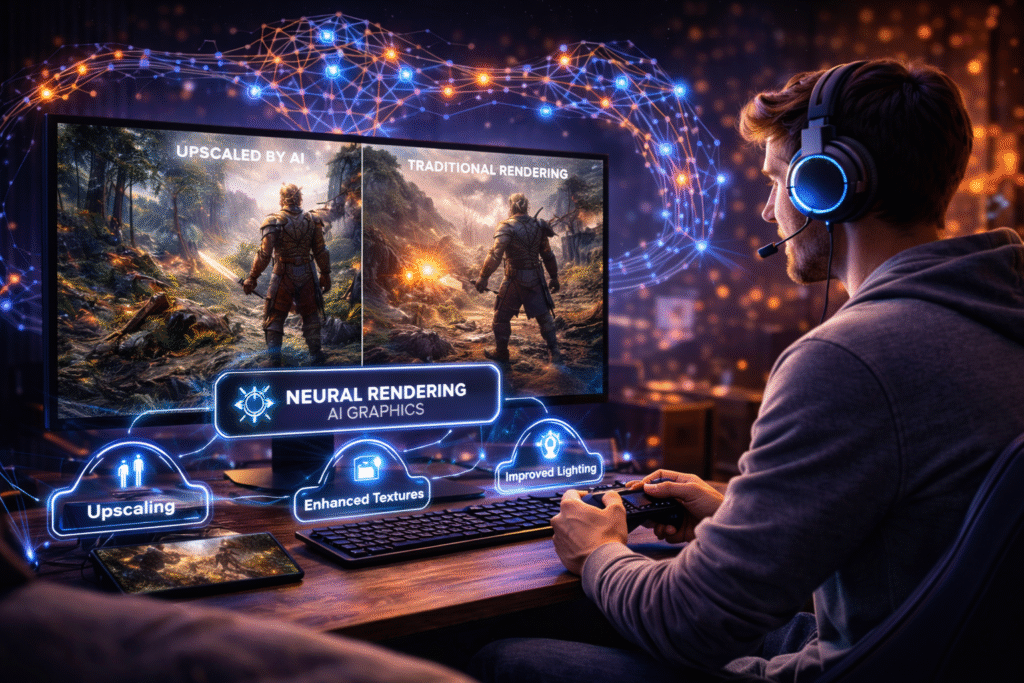
What if games didn’t need to render every pixel the traditional way?
What if AI could generate visuals in real time, making games look better while using less power?
This is the rise of neural rendering — one of the most cutting-edge and viral technologies transforming how games are created and experienced.
🧠 What Is Neural Rendering?
Neural rendering uses AI models to generate and enhance graphics instead of relying entirely on traditional rendering techniques.
Instead of calculating every detail using hardware alone, AI can:
- Upscale low-resolution images to high quality
- Generate realistic textures
- Improve lighting and shadows
- Predict and fill missing visual details
This makes games look better while reducing performance demands.
💻 Revolution in PC Gaming
PC gaming is leading the adoption of neural rendering technologies.
Companies like NVIDIA are already using AI-based systems such as DLSS (Deep Learning Super Sampling) to boost performance and visual quality.
With neural rendering, PC gamers can experience:
- Higher frame rates
- Better image quality
- Reduced hardware strain
This allows even mid-range systems to run high-end games smoothly.
🎮 Console Gaming Gets Smarter Graphics
Modern consoles such as:
- PlayStation 5
- Xbox Series X
are also integrating AI-based rendering techniques.
This helps deliver:
- Enhanced visuals without performance drops
- Faster loading and smoother gameplay
- More detailed environments
Console gaming is becoming more efficient and visually impressive.
📱 Mobile Gaming Becomes More Advanced
Neural rendering is a game-changer for mobile devices.
Smartphones have limited hardware, but AI can compensate by:
- Enhancing graphics in real time
- Reducing power consumption
- Improving performance
This allows mobile games to look closer to console-quality without draining battery life.
🏆 Impact on eSports and Competitive Gaming
In competitive gaming, performance is everything.
Neural rendering helps by:
- Increasing frame rates
- Reducing lag
- Maintaining visual clarity
Players can enjoy smoother gameplay without sacrificing performance — a major advantage in fast-paced matches.
⚠️ Challenges of Neural Rendering
Despite its potential, neural rendering has challenges:
- Requires advanced AI models
- May introduce visual artifacts
- Needs continuous training and optimization
- Not yet supported in all games
Developers must carefully balance AI enhancements with visual accuracy.
🚀 The Future of AI-Generated Graphics
Neural rendering is pushing gaming toward a future where AI plays a central role in graphics.
In the coming years, we may see:
- Fully AI-generated environments
- Real-time cinematic visuals
- Reduced reliance on expensive hardware
Games may no longer rely on brute-force rendering.
Instead, they will be smart, efficient, and AI-driven.
The question is no longer:
“How powerful is your GPU?”
It’s becoming:
“How smart is your game engine?” 🎮


