

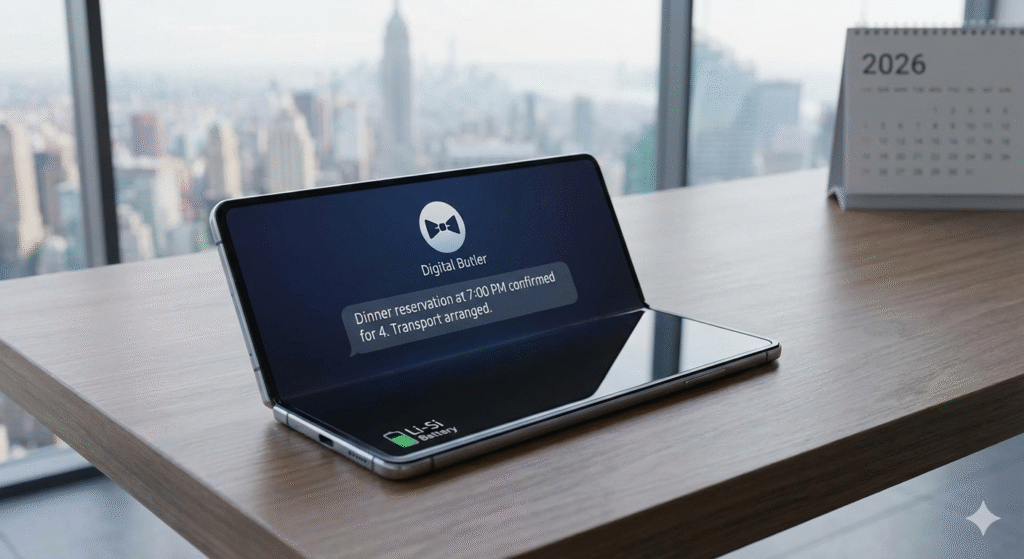
As we enter 2026, the smartphone has reached its most significant turning point since the introduction of the multi-touch screen. We have moved past the era of “AI as a feature” and into the era of AI as the Operating System. The devices launching in early 2026—from the Samsung Galaxy S26 Ultra to the rumored “iPhone Fold”—are no longer just communication tools; they are proactive agents designed to navigate our lives for us.
I. The Rise of Agentic AI: From Chatbots to Do-Bots
In 2026, the industry has shifted from Generative AI (which creates content) to Agentic AI (which takes action). This is the year of the “Digital Butler.”
- Autonomous Workflows: Your phone now has the agency to perform complex tasks. If you receive an invite to a dinner, your “Agent” doesn’t just put it on the calendar; it checks your commute, looks for a table at the restaurant, and suggests a gift based on the host’s preferences—all before you’ve even tapped a button.
- On-Device Sovereignty: Driven by the Snapdragon 8 Elite Gen 2 and Apple’s A19 Pro chips, these agents run almost entirely on-device. This “Local AI” means your personal data never touches the cloud, offering a level of privacy that was impossible in the early 2020s.
- Contextual Anticipation: Using advanced “NPU-first” architecture, 2026 phones anticipate your needs. If you arrive at the airport, your phone automatically surfaces your boarding pass, converts your currency, and provides a real-time summary of your destination’s weather and transit news.
II. Form Factor 2.0: The Tri-Fold and the “Air” Era
Hardware design in 2026 is no longer about “the glass slab.” It’s about Transformative Geometry.
| Trend | Innovation | Key Player |
| Tri-Fold Supremacy | Devices that fold twice into a Z-shape, expanding from a 6-inch phone to a 10-inch desktop-class tablet. | Huawei (Mate XT), Samsung (Z Tri-Fold) |
| The “Air” Design | A new class of ultra-thin, lightweight flagships that focus on “invisible” pocketability over sheer bulk. | Apple (iPhone 18 Air), Xiaomi |
| Hole-less Displays | Under-Display Camera (UDC) tech has finally matured, offering 100% screen-to-body ratios with zero loss in selfie quality. | Samsung S26 Ultra, Oppo |
III. The Battery Revolution: Silicon-Carbon Goes Mainstream
The greatest hardware breakthrough of 2026 isn’t a screen or a camera—it’s the battery. The industry has finally moved away from traditional Lithium-Ion toward Silicon-Carbon (Si-C) anodes.
- Higher Energy Density: Si-C batteries allow manufacturers to pack 7,000mAh to 8,000mAh of capacity into the same physical space that used to hold only 5,000mAh. This means “two-day battery life” is now a standard for flagships rather than a marketing myth.
- Extreme Thermal Management: To handle the heat of on-device AI and super-fast charging (now pushing 240W on some models), 2026 phones use “active-passive” hybrid cooling systems featuring massive vapor chambers and heat-dissipating Graphene layers.
IV. Sustainability and the “7-Year Standard”
Following the 2025/2026 EU mandates, “planned obsolescence” is officially dead. The smartphone of 2026 is built to last until 2033.
- Modular Repairability: Most flagships now feature “no-glue” battery designs, allowing users to swap their own batteries with simple tools.
- Software Longevity: Apple, Samsung, and Google have all synchronized their update cycles to a minimum of 7 to 10 years of OS support, treating the phone as a long-term investment rather than a disposable gadget.
- Recycled Materials: The “Mineral Crisis” of late 2025 led to a surge in 100% recycled cobalt and gold usage, with many 2026 models carrying a “Net Zero” carbon certificate.
The smartphone in 2026 has become an invisible, intelligent layer between us and the digital world. It is thinner, smarter, and more durable than ever before, acting less like a device and more like a trusted companion.


